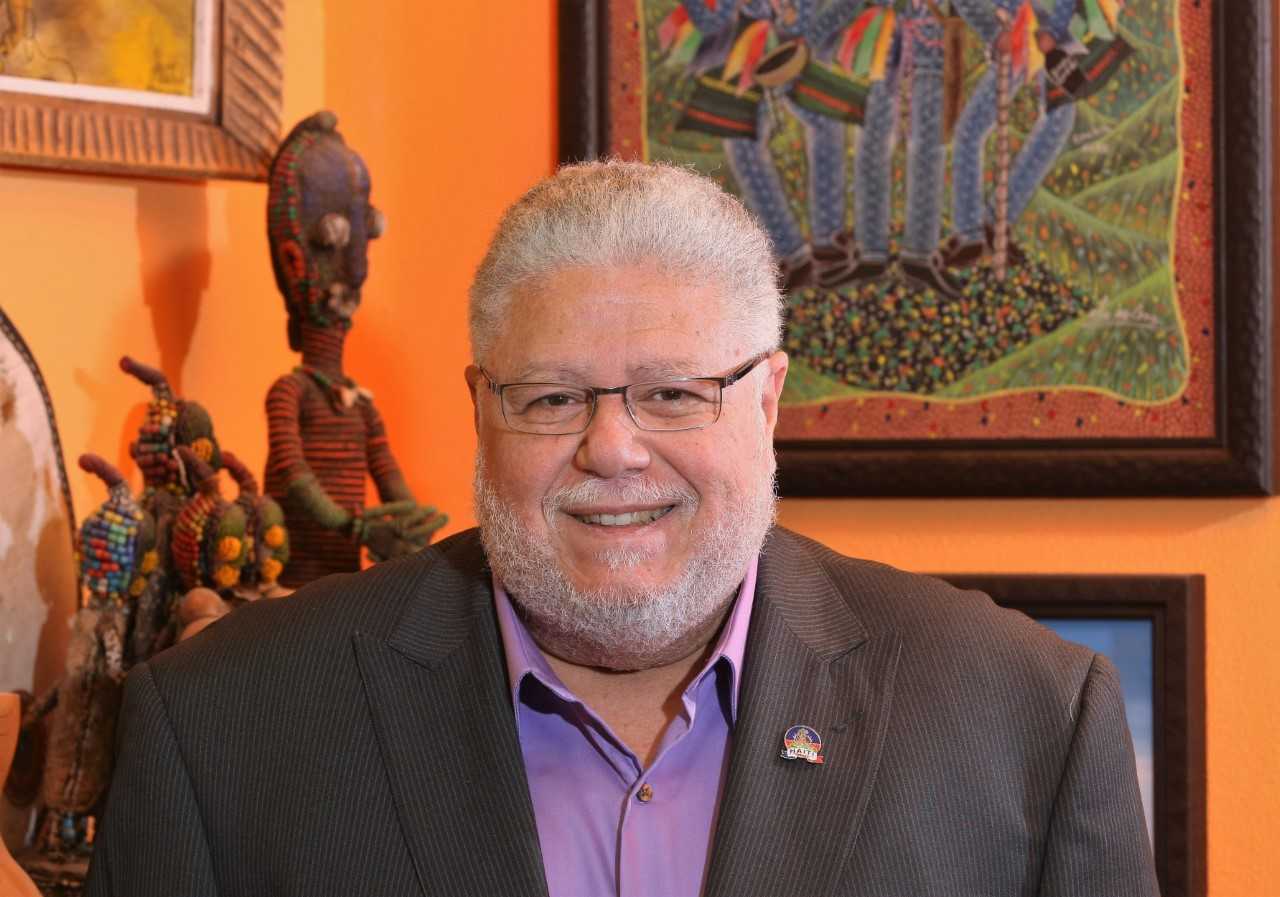
The Scholar and the Houngan: A Life in Haitian Vodou
Key points
- Patrick Bellegarde-Smith, scholar and houngan, describes Vodou as a system in which all things are conscious energy and the divine lives inside each person.
- He explains that African religions do not seek converts, and that Vodou's coexistence with Catholicism grew out of the need to survive.
- Bellegarde-Smith teaches polarity, the coexistence of good and bad in every being, and the principle that there is no punishment, only consequences.
- He explains why the favorite child carries the heaviest burden, and why in Vodou the law comes from the ancestors and not from God.
- Bellegarde-Smith notes that Haiti has more manbos than houngans, and that every Haitian leader since Dessalines has had some knowledge of Vodou.
- He describes knowing as a child in Port-au-Prince that he would become a priest, and the formal initiations he underwent before practicing openly in the academy.
In this first episode in the Ginen mini-series, we cover the central tenets of Haitian Vodou, the life, love, and expansive mind of the distinguished scholar, Patrick Bellegarde-Smith. Professor Emeritus Patrick Bellegarde-Smith received his doctorate in international relations, comparative politics, and Latin American Studies, in 1977. He taught in the field of international development, political economy, and culture, at Bradley University, then later, at the University of Wisconsin-Milwaukee, in the field of African-American Studies with a focus on Caribbean cultures, politics and history, Afro-Caribbean religions, and in the area of Black feminisms. He is the author or editor of five books, among them, In the Shadow of Powers (Humanities Press International, 1985, 2nd ed. Vanderbilt University Press, 2019), The Breached Citadel (Westview Press, 1990, 2nd ed. Canadian Scholars Press, 2004), and Fragments of Bone: Neo-African Religions in a New World, ed. (Illinois University Press, 2005). The sixth book on gender identities and African religious systems is in preparation. Some of his writings have been anthologized, notably, "Hormones and Melanin: The Dimensions of 'Race,' Sex and Gender: Reflexive Journeys," in Jacqueline Bobo et al., The Black Studies Reader (New York: Routledge, 2004).For his work on issues of ethnic, racial, and national identities, he received from the State University of Haiti, the Jean Price-Mars Medal in 2013, and the Lifetime Achievement Award for Scholarship from the Haitian Studies Association in 2010. Some of his books and articles have been translated into French, Spanish, Kreyol (Haitian), and Portuguese.Bellegarde-Smith served as the President of the Congress of Santa Barbara (KOSANBA), a scholarly association for the study of Vodou and other African-derived religions, and is a former president of the Haitian Studies Association, (HSA). He is an associate editor for the Journal of Haitian Studies and served on the editorial boards of Kalfou: A Journal of Comparative and Relational Ethnic Studies, and the Journal of Africana Religions. He is an advisory board member/Elders-Distinguished Member of the Institute for the Study of Canadian Slavery, in Halifax, NSCAD, Nova Scotia.He is a Houngan asogwe, a priest of Haitian Vodou.He attended The University of the Virgin Islands, the "youngest" HBCU, Syracuse University at Utica College, and The American University, School of International Service.Dr. Bellegarde-Smith is the author of many books, including In the Shadow of Powers (1985, 2nd edition 2019), The Breached Citadel (1990, 2nd edition 2004), Fragments of Bone, ed. (2005). For his books and articles on issues of national and personal identities, he received from the University of Haiti, the Jean Price-Mars Medal in 2013, and the Lifetime Achievement Award for Scholarship from the Haitian Studies Association in 2010. Some of his works have been translated into French, Spanish, and Portuguese, and some of his writings are anthologized.
Transcript
9,518 words · 41 min read
Machine transcript. Names and Kreyòl words may be misspelled. Tap a time to play from there. Also on Jou.
Patrick Bellegarde-Smith Yonjou, lwa ginen yo ap tounen. Pou yo vini, ne tiepe ya, mette diab yo de yo, pou pep vayan kapab rebati la kaye. Se mesaj sa ak te gen an chante yo, se mesaj sa ak te gen an kout tambou yo, se mesaj sa ak te gen an kout tambou yo, se mesaj sa ak fe tambou pa jamm su sponbat.
Patrick Jean-Baptiste Hi everybody, this is Patrick Jean-Baptiste. We have a very, very special guest today, the great Dr. Patrick Belgard Smith. This is part one of a multi-part series and today we are going to do a deep dive into Haitian voodoo. And the following series will cover his personal life, his biography, his personal biography, and his other works on religion, politics, and so on. I know you're going to enjoy this episode as much as I did. Thank you. Thank you. You're very mystical. Yes, yes.
Patrick Bellegarde-Smith To all the indigenous people, all of you. Yes. Mysticism is a fleur of water. It's Hinduism, the same people. Buddhism, the same people. Amerindians, the same people in America. It's because we have a rapid connection between the divine and everyone. Everyone has access directly to the divine source. You don't need to be prepared necessarily to contact the other side. The ancestors are there, the dead are there. You are always there with us. It's a family. You have a direct connection with us. And then, everyone is created by God. So, there's no need to invent Satan. Because the binary question is, from the two sides, one or the other, bad and good. Bad and good are working together. So, bad and good are working together. So, it's the right to decide who is left, who is left. Because we are in the assembly. It's true.
Patrick Jean-Baptiste So, it's not a question of binary. Satan is there. It's John. It's a bad moment. It's a good moment.
Patrick Bellegarde-Smith Yes, yes.
Patrick Jean-Baptiste Like everyone. The thing is not very decentralized. It's not systemic. It's not a hierarchy. So, how are you? How are you? Like the one that's inside. Good God.
Patrick Bellegarde-Smith Good God inside. No, no, no. He is inside. So, the people of Israel say, it's not an external force. God is not an external force. It is inside you. Uh-huh. And so, there is no need to go to the outside. Just close your eyes. Just close your eyes and you will meet the divine. And remember that in Hinduism, remember Namaste, the way people greet each other. The way people greet each other is, I salute the divine in you.
Patrick Jean-Baptiste Uh-huh.
Patrick Bellegarde-Smith So, it's the same way that we gain force. And so, it's energy. You see, in physics, they will tell you that all things are energy.
Patrick Jean-Baptiste Uh-huh.
Patrick Bellegarde-Smith In African religious systems, they tell you all things are conscious energy. Uh-huh. It's the difference between religion and science. The science is all energy. Uh-huh. Religion, everything is conscious energy. Energy is the conscious of it. It's the inside of it. Yeah. Of course. But Patrick, even if you're the inside of it, the man does a discourse in the university or the other side. The people who come out of the land, they cry and say, Oh-oh, it's the same way that we have the same concept. A professor amérindian at my university, I'm joined the night, and then they start to cry, Professor, a man who's 65, Oh, but it's not Indian. Oh, I'm saying, no. It's amérindian. Yes, it's an open. Alors, it's universel. In this sense, it's universel. These are the things of nature. And the way to talk about nature, it means science. Uh-huh. It's not a secret in science. It's not a secret. But you're the divin, all the stuff of nature. Or animals. Or plants. The man who's in Haiti, we always do it. I'm talking about plants. If you're talking about plants, you're growing faster. That's what I'm saying. I'm talking about plants. And then, when the man was on a pelouse, I was walking on a pelouse, I said, I'm sorry. Because I'm walking on a pelouse. I'm walking on a pelouse. And then, you say, oh, but you're a superhuman. I'm talking about it. Everything is divine. Then you're a good guy. Everything is a good guy. It's the unicity of the cosmos. Everything is one.
Patrick Jean-Baptiste And is it because of intimacy between us and nature, or we're part of nature, or we contain the divine in us, is it the meaning of proselytizing the religion? It's like Christianity. Yes. Or maybe you try to convince or create a whole system to try to convince or subjugate people to take up your religion. Everybody decides whether they want to take it up or not. You can't talk about it. Yes. You can't talk about it.
Patrick Bellegarde-Smith It's the imperialism. I'm talking about it. The African religion is not not a conversion. It's like Judaism. You can't accept it. It's very difficult to become a Jew. Because it's you're the same who's going to be. You're not necessarily going to come. You're not going to come. And then, in the African religions, each tribe has a religion. Each tribe has a religion. So, if you're not of this tribe, you don't have a right to enter in the Bahrain Sahara. But, there's no proselytism in the world. There's no proselytism in the Bahrain Sahara. So, you belong to this tribe. So, you belong to this tribe. And if you belong to the tribe, it's the spirit that you're going to come. You're going to come. Express, it's going to come. For example, I have a friend in the Bahrain Sahara. A Brazilian white, who is a Catholic Catholic. We're going to come. It's a Catholic. But, the idea is that, the young people, Simone, that the priests have a priest in the Bahrain Sahara. A priest, like a priest in the Bahrain Sahara, for example. It's free. You say, we like you, we want you to become a Roman Catholic priest. I want you to become a Muslim. I want you to become this. I want you to go into the Paracetism because this is where we need you now. We need you there now. Okay? Wow. But, in fact, in the African sense, in fact, it's already decided because there's a conversation. There are conversations between you and the rest of the spirit world as to what it is that you have to do once you return to the planet. And so, priests are not made. They are born. They are born priests. And whether or not you realize it, l'enjeclet, comme on dit en Haïti, c'est une autre question. Mais, this was your path. When I went to Israel, and every day for the two weeks I was there, I was mistaken, not only for being Jewish, I was mistaken for being a rabbi. And people would come to me and say, rabbi, may I ask you a question? Au Brésil, mal et long, l'entempe, condomble, rabbi, comme ça, vous n'y a genouille de vannes parce que il y a un ouest amie. Il n'y a pas besoin de l'une question. Ce que je veux dire là, c'est que vous rentrez dans la situation et puis vous n'y a regardé où on a écrit les sassons ou sondé les mounes. You look at the person from a distance and you know what that person is all about. When I go into the countryside in Haiti, I'm a little bit fearful because people can see right through me. People can see right through me.
Patrick Jean-Baptiste All right? Yeah. So, energy, ça a où exude l'universel? Toutes les personnes viennent. Toutes les personnes
Patrick Bellegarde-Smith viennent. Parce que nous, toutes créatures divines,
Patrick Jean-Baptiste toutes les personnes,
Patrick Bellegarde-Smith parce que divin, c'est en dedans où il y a.
Patrick Jean-Baptiste So, on pense de, on a parlé de symbiosis, sans penser de sujet, comme si mélangement avec religion catholique, avec vodou, qui trouvent l'anbarre,
Patrick Bellegarde-Smith ça? Oui et non. Toutes les personnes disent oui et non. Oui, ce n'est pas oui. Non, ça, c'est peut-être une question, c'est tout, c'est un bain, you have to survive. You have to survive to such an extent that you had to adopt the Roman catholic saints as a shield and pretend that you knew what it was about. Cuba did it. Brazil did it. Haiti did it. You would not survive otherwise. Remember that during slavery in the US, in Trinidad and elsewhere, African enslaved Africans were forbidden to play the drums, forbidden to play the drums, forbidden to dance because it was connected, it was seen by the slave owners as religious. In Congo Square, in New Orleans, for instance, you had ceremonies in Congo Square in front of the cathedral and everybody thought it was very cute. The Africans are dancing. Those were religious ceremonies disguised as dance, disguised. So we had to wear the mask. Paul Lawrence Dunbar, the African-American poet, said, we wear the mask that grins. and he goes on with that wonderful poem that we have to use subterfuge in order to survive. So we pretend to become Christians. We pretend to do this. We pretend to do that in order for physical survival to continue. And that is important. So you do have things that come into the religion, especially in Haiti. Haiti is unique in that it brings together West Africa and Central Africa. It brings in the European people. It brings in people from what is now Benin and Togo and Ghana, but also it brings in Angola and the Congo. It brings it all together. So we are talking about all those nations that contribute to the formation of Haitian voodoo. But on top of that, there are intrusions from Christianity and from Islam as well. You have words from Arabic that comes into the system because some of these enslaved Africans, like Bukman, were Muslims. He was, yes, he was an but he was also an Imam at the same time. I have seen in Senegal, for instance, Muslims who at night when nobody is watching, go to the Marabout. to ask for advice. I have known of Haitian pastors, Protestant pastors, who go see the hunger at night when nobody is watching to ask for advice, for instance. It's all spirit stuff. And the spirit stuff is rather unified and it's universal. So it does not matter how you practice necessarily, it's what you have in your heart.
Patrick Jean-Baptiste So is the question or the pursuit of trying to find purity within current day voodoo practices, whether in Haiti or in the academy, do you think that's a fruitful pursuit or should just accept all properties of current voodoo practices as it is today and just move on? What are your thoughts on that?
Patrick Bellegarde-Smith It keeps changing. Everything changes in life. Nothing is pure. DNA is proving that all these white people who are white supremacists in the U.S. have some African ancestry and they're devastated when they learn that because we have DNA. Nothing is what it seems. Nothing is what it seems. When, for instance, Mama Lola, who was a very well known, Mambo, out of Brooklyn, New York, and she died a few years ago, when she went to old Apple now Benin with Karen McAfee Brown who wrote the famous book about her, she had, when she went to voodoo ceremonies in Benin, they said, oh, we have known that in generations. Haitians have kept it going. The Beninois have moved on. They do something else. When you hear the French spoken in Quebec, it's not the French that you hear in Paris, France. Well, the French have moved on. The Québécois have held on to the French, even if it sounds like the 18th century. changed. We hold on to the provinces in the provinces, in the new world, which Africa has given up a while ago because nothing remains stable. Nothing is static. The world changes and the universe changes. It's okay for change to occur. There's nothing wrong with that. The basic principles remain. The basic principles remain. The form changes.
Patrick Jean-Baptiste One of the things you talk about, you write about is polarity, how opposites subsist within each entity.
Patrick Bellegarde-Smith Can you expand on that for us, please? Good and bad, good and bad. Good and bad resides in the same entity. I am evil and I'm good. It depends on the time of day. It depends on whether or not I had my coffee. But the fact of the matter is, and the way you see this, is that God is immensely good and beneficent. God can be immensely evil at the same time. So there is no need to create an entity outside of it. Because remember that the Satan of Christianity, the Satan of Judaism, and the Satan of Islam, is a creature. That was one of the fallen angels. So it is a creature of God. And so why invent an entity that is far weaker than God itself? Because God is neither a he nor a she. It is an it. Spirit have no sex. They don't have bodies. Therefore, it's not a he. But the point of the matter is, why invent an entity outside of the deity itself, and so assume that it has all that power? Satan has no power unless that power is given to it by God. God can get rid of Satan, because God created Satan, right? That is, in the view of the Abra, of the view of the religions of the book, Judaism, Christianity, and Islam, that are the three religions that are far different than all other religious systems in the world. those are very patriarchal, those are very male dominated. God is a he in all three. In the African system, God is not necessarily a he nor a she. God is God.
Patrick Jean-Baptiste What did you mean by there is no punishment, only consequences?
Patrick Bellegarde-Smith Every action has a reaction to it. If you do evil, and we are allowed obviously to do it, it is our own choosing, we will be punished. This is why, of course, in India they call karma. So there is no need for any divine creature to punish you. You punish yourself by your own actions. And so it's a matter of karmic justice. You will be punished by yourself. The Yoruba have a prayer in Ifa may my enemies rise up to their own destruction. They will destroy themselves. I don't need to do it. That's not my job. And so there is no external force that will punish you. You will be punished by the actions that you have created. You have a right to commit evil, but you will be punished by yourself, by your actions. reincarnation comes in, by the way. Because what you do in this world will affect your behavior and your actions in the next world. Abraham Lincoln, President Lincoln, believed that, by the way. He's one of those Americans among tens of millions of Americans who are Christians who believe in reincarnation.
Patrick Jean-Baptiste Really? Okay. You said humans and perhaps others and I want to kind of focus on who are the others you're talking about. Spiritual entities choosing a corporeal existence. Is there, so we're spiritual entities first? Yes. And then we choose a corporeal existence and who are perhaps the others you're talking about?
Patrick Bellegarde-Smith Well, in Christianity for instance, you have the angels, they have the archangels, you have the cherubims, you have the seraphim and other spiritual entities. We are all of these things. We choose for our purposes to have a body. But the body is obviously only temporal. You will live 60, 65, 70, 80, 90 years old and then you give up that body. But you will return because your source, your essence is the spirit. Your essence is not that particular body.
Patrick Jean-Baptiste Okay. So, what do you mean by the favorite child carries the heaviest burden? That's an interesting, I have children. Yeah. What do you mean by that?
Patrick Bellegarde-Smith Well, it's not you choosing. one makes parents make a great deal of effort not to have favorites. One tries not to have a favorite because it's not fair to all the other children. But one has to treat children separately from each other because they have different needs and therefore one cannot treat them exactly the same because they are not the same person. And this came to me, for instance, when I realized the burdens that black people have had for the past many, many centuries. And it seems to me that we have a special role to play in the universe, certainly on this planet. In the very same way, for instance, Jews are always asking themselves for the past several thousands of years, why does it always happen to us? Why are we mistreated and discriminated against and killed on sight over the past several thousands of years? For instance, the way I look at Judas, for instance, it appears that he was a favorite of Jesus, a favorite disciple. But he had a role to play. And if he had not played his role, nothing else would have made sense. He was supposed to deny Jesus. He was supposed to turn him over to the Romans that eventually killed him and crucified him. And so he probably has a very good seat next to Jesus right now as we speak. They loved each other, but he had to play that particular role.
Patrick Jean-Baptiste The concept of imbued by wisdom ancestors legislate. Can you expand on that as well?
Patrick Bellegarde-Smith The law, in terms of that mindset, the law is not given to us by God. The law is given to us by the ancestors, which means that the dead, in the very real sense, have a great deal to do with the living, because the dead are not dead. And the reason that they are in charge of the laws, as it were, you know, in quotation mark, the law, depending on how one defines it, is because they are close enough to us to know what we can do and what we cannot do. In other words, they don't demand of us impossible tasks. You are given the burden that you might be able to deal with. You are never given a task that is too heavy for you to do, because the divine knows the restrictions that you have personally. And so, the ancestors, having been human, like us, in the proximate future, know exactly what we can deal and cannot deal with. They don't demand that much of us. Just a small effort might satisfy them. And so, tradition has a lot to do with the way we run our lives. Rituals are part of all this. And, you know, we refer to the dead, but in the African mindset, in the mindset of the rest of the world, they're not really dead. They're still around.
Patrick Jean-Baptiste I want to come back to the favorite child carries the heaviest burden idea. sensations have suffered so much. Are we God's favorite? Well,
Patrick Bellegarde-Smith let me illustrate. When my mother died, my siblings told me, oh, you were her favorite child. You were her favorite child anyway. I never knew that I was her favorite child because she gave me a lot of things to do. I had a lot of tasks. I was raised in a way that I was almost never a child. I was an adult from the time I was 10 years old, as far as she was concerned. And so I had a lot of burden placed upon me by my mother, yet my siblings saw it as being her favorite child, even though I saw it differently. But, well, I have to say that I was the only child who maintained the creole language. And so that really helped communicating with my mother in her own maternal language, Haitian creole.
Patrick Jean-Baptiste Mm-hmm.
Patrick Bellegarde-Smith Associe, associe, oh, wemwe. We love you. Associe,
Patrick Jean-Baptiste ou te pasé, malasé, ou lo ani, wem, ou é kom, amwé, marile, lua, asin, yo. Marile, lua, tomb 있습니다. The concept of can you flesh those out?
Patrick Bellegarde-Smith Well, the words, of course, are our ancestors. Those people who have lived with us and have since departed this earthly realm. Let me stay while talking about spirits. We're talking about the lois themselves or the orisha in the Yoruba IFA system. And what was the third one? The twins. Well, yeah. The malasa is those are spirits, of course. The twin, the idea of twinness is very significant, especially in the Yoruba system because the Yoruba people in Western Nigeria are famous for producing a lot of twins. Not all societies produce as many twins as they do. And so, they become significant in terms of that particular society. In Haiti, those are the spirits representing the children. children. They have very powerful and very capricious because they are considered to be children in that sense. But one thing I have to say right away, the third child, the child that is born after the two twins is even more powerful. So, we talk about in Haiti about malasa toit. Malasa toit. The child born, girl or boy, after the twins is even more powerful. And we have the concept of one plus one equals three. And this is, this is, and three is a, is a sacred number in pretty much every religious system on the planet Earth. I don't know exactly why, but three is a very powerful number. We have it in Christianity, of course, the Holy Trinity. But three is important that way because it is greater than the sum of its parts.
Patrick Jean-Baptiste What's the role of the wuga and mambo and voodoo?
Patrick Bellegarde-Smith Well, those would be consistent with, they would be like the rabbis back home or the priest in, or the pastor in other systems, certainly. These are seen to be natural leaders in the countryside, certainly, and highly respected individuals who have knowledge, and they have knowledge. But the one thing that comes through in terms of the system and is connected again to somewhat to reincarnation, is that priests are not made. They come on Earth already with that particular duty, that particular function in life. So before you come back to this Earth, you know what it is that you need to do. Of course, you forget coming back to Earth, so you have to be reminded from time to time that this is your purpose. Everybody comes on the planet with a particular purpose, which they try to fulfill.
Patrick Jean-Baptiste Are there any gender equity issues in Vodou?
Patrick Bellegarde-Smith No, no. There are more Mambou than Hunga, it seems, in Haiti. And it's throughout the African system, men and women are, they may have different realm oftentimes, however, their power is equal. There are as many so-called female spirits as male spirits, even though spirit has no sex and spirit has no gender, but for ease of comprehension, we have assigned a gender to these, to the spirit world. Christianity is the same. You have God the father, God the son. And it occurs to me, of course, early in my childhood, that God could not have, could not be a man nor a woman for that matter. It is more of an it. But we don't talk that way in terms of the Western world. A spirit has no sex or gender, but we have assigned these for ease of comprehension. What we are talking about is a feminine essence and a masculine essence which resides in all individuals, everybody, and the spirit world included, I guess, in the sense that the human being has testosterone and estrogen in his or her body, no matter what the sex is, actually. So that's the way nature deals.
Patrick Jean-Baptiste I talked to you at that channel about this. I just wanted to know if you could sort of explain the journey of the word, the etymology of the word voodoo as V-O-O-D-O-O and your role and other intellectuals like you and making sure that the new pronunciation is V-O-D-O-U. What's the story behind that and what are some of the issues? You talked about some organization that you finally got to change the Library of Congress or something to that effect. Can you flesh that out for us?
Patrick Bellegarde-Smith Well, in Haiti, as in African systems in general, religions are not given a name because every ethnic group, every national group, every society, every group of human being has one religion. the absence of other religions indicate that each people has devised for itself a language and a religion. In Denmark, they speak Danish. In Sweden, they speak Swedish. In Norway, they speak Norwegian. And those are very small societies, by the way, sometimes with less population in Haiti itself. And Haitians have devised the Haitian Creole language, which is a language, and they have devised a religion based on their ancestral roots. So there is no need to give a religion a name. In fact, there are no name for religion because that's what the group does automatically. Automatically. Now, in the presence of other religions, as they come into your territory, you have to be able to differentiate between the dozen also religions that come to be. But this is fairly new in the course of human history because every people has its own religion, which is not by the way found elsewhere necessarily. And so in Haiti, what you had very much was people were saying, well, people were saying, do you serve the spirit? They don't say, do you practice voodoo? Do you serve the spirit? And the answer, yes, I serve the spirit. That spirit in the singular or the plural as you wish. But there are, of course, dozens and dozens of religions practiced in Haiti as we speak so that you need to differentiate between the various ones. Now, in voodoo, for instance, you can practice a plethora of religion without feeling guilty about it. Remember that Bookman, born in Jamaica, is reputed to have been an imam in Islam. He was also a hunga. So he was fulfilling both functions. I don't know what Cecile Fatima was practicing, but she was certainly, she was certainly imambo. Whether or not she was a Muslim woman, the name Fatima sort of brings that to the fore. And so, you have, in Haiti, people will practice several religions at once because everything is spirit stuff and everything has power. And so, the more that you have it on your side, the better off you are in that sense. Now, other religions are exclusive. Once you become that religion, you're expected to abandon the other ones. By the way, and because each society has its own religion, converts are not possible. Conversion is not possible. You do not convert to voodoo. In the very same way that, in a sense, you're not supposed to convert to Judaism. Judaism is for Jews. And they would rather not have people come into it. In the very same way throughout the ancient world, you had your own and other people next to you have their own religious system. You are called by the spirit to become a voodoo. You do not convert to it. That is an impossibility. Now, the term voodoo is pure Hollywood. Remember that the United States occupied Haiti between 1915 and 1934. And so, it had to justify that expansion of its territory because at the very same time, the U.S. was invading countries in Asia, invading countries in the Caribbean, et cetera, et cetera. So, Hollywood, of course, as good Americans, decided to be part of that enterprise. And so, they created VOODOO to label black people superstitious and that kind of thing and practicing witchcraft, which we do not do. And so, that was justification for it. And because they knew nothing, nothing about voodoo, what they used was essentially British witchcraft and German witchcraft, which they knew something about. And they had dolls and pins and that kind of thing, which is not found in our religious system. They made it up, essentially, and people bought it. And so, and it invaded the world and just justified the occupation of Haiti by the American Marines, in which maybe about 50,000 Haitians were killed. 50,000.
Patrick Jean-Baptiste starting with Suluk, my next question to Patrick had to do with how successive Haitian presidents use voodoo.
Patrick Bellegarde-Smith Suluk was given the bad press to a large extent in all quarters for all kinds of reasons. there is some evidence that every Haitian leader from Desaline all the way to the present day has knowledge of voodoo and some of it used it for evil and some of it used it for good in terms of assuraging the Haitian population. But even during the persecutions of a religion and there were many waves of persecution in Haiti the presidents who were most likely to persecute the religion also had their in the countryside people like Elile Sko for instance and other presidents so they were cognizant of it they knew about it even as they pretended not to do anything about it but you see it was a matter of not don't shame the country because white people are watching you many of us pretend that we speak fluent French when we only speak Creole many of us say we don't know anything about Vodou even if we are hungers ourselves because we want to put our best foot forward for white people I gave that up a long time ago in my life I don't go out to try to please white people I never have never will and so I am bold in my assertion of my Haitianness in that sense but I don't think Vodou did not become official under Suluq I'm sure he practiced it as others have in the presidential palace but on the wraps because we want to make sure that we are seen as civilized by the rest of the world and we have always been civilized but somehow we were not defined as such by the western powers
Patrick Jean-Baptiste this is a good jump off point then to start talking about your personal life how is it that you when you were in the academy what made you decide to quote unquote be very open about your practice in the academy are you someone once told me there are more practicing UGA Haitian professors than who are letting on but you are one of the ones that are like unabashedly out there or were out there with it what made you decide at what point did you decide to do that what was the catalyst or how did you was it incremental how did you come up to the point where you said you know what this is who I am and damn the consequences
Patrick Bellegarde-Smith well I always knew I always knew that I was supposed to be a priest of which religion I was not sure obviously and in Port-au-Prince as a young child I knew already at six seven eight years old that I was going to become a priest but at that time I was a student at Petit Seminaire Collège et Marcial and run by the spirit and by priests on all the French order of priests and I was prepared to go into the Roman Catholic priesthood and thank God I didn't do that because that was not my road and so people are born with the express idea that something like this is about to happen or should happen and the matter is to figure it out once you have reached this earth and you have reminders placed at various points in your life to say remember this is what you were supposed to do that was your purpose on this earth at this time and in the very same way for instance that I have been interested in issues of nationality and nationhood throughout the world and how small nations survive in the world of very powerful forces of mega nations and one way that they survive is by keeping their religion and their language going this is certainly what gives us our presence in the world and what makes us different from other people certainly and so but certainly having achieved tenure eradicate the idea that I'm going to be punished necessarily but punishment is always there and I was warned not to say anything about having to do with Vodou because I would lose all credibility well you see it's interesting because when I wrote my second book for instance Haiti the Breached Citadelle one of the reviewers said do not read that book do not trust that book because he appears to like his country he appears to like his country as if this was a sin when Americans write about the United States nobody says they appear to love the United States but somehow it makes you suspicious if you're Haitian and you write about Haiti even though you think you're being quite objective and I think I was in the very same way people are saying you cannot trust a homegirl writing about Vodou well rabbis write about Judaism Catholic church Catholic priests and Protestant ministers write about Protestantism in the Catholic church and they are never accused of you cannot trust them because they practice that religion but you see there is a different way of looking at black individuals in this country you cannot trust these people because they cannot be objective they cannot be real and they have an axe to write and this is simply false of course and this is part of that racist environment that we have to survive in and so I always know I knew I was going to become a priest I didn't know it was going to be Hong Kong but this was my path and I had other paths before that I'm sure but I don't recall them.
Patrick Jean-Baptiste So you decided to I mean was it was it formalized in terms of how you came out about your practice about being a Uga or was it just kind of you just kind of naturally started talking about it public what was sort of the process you know how you let the world know?
Patrick Bellegarde-Smith You have to go through many many many initiations in Haiti or elsewhere for that matter where Haitians have established themselves in New York and Montreal and Miami and other places certainly but you have to undergo formal initiation certainly and this is of course what happened to me. Now to backtrack just a little bit a friend of mine in Bahia, Brazil young Afro Brazilian always knew that he was going to become a Pai de Santo in Candomblé which is of course the Brazilian version of Vodou if you will based on the Nigerian system and but the Orisha which is the Loire in Brazil said to him well we love you dearly you are our child but we do not want you to become a Pai de Santo we want you to become a Roman Catholic priest which he did. Okay so the Loire themselves can tell you this we don't need you here we need you over there rather and so you have people who believe in Vodou who believe in the ancestors who become Roman Catholic priests or Protestant ministers for that matter or Imam sometimes it is this is where we need you at this time. this is not your path this other religious system is your path at that time and they will tell you that we don't want you in Vodou we want you to become a Roman Catholic priest and those are the Loire telling you that and so my friend became a Roman Catholic priest.
Patrick Jean-Baptiste so that was kind of a similar thing the spirits told you to pursue yeah
Patrick Bellegarde-Smith oh yeah they tell you that and if you say yes then you have to follow through because this was the reason that you were born in the first place
Patrick Jean-Baptiste was the message pretty direct or did it come incrementally
Patrick Bellegarde-Smith it was pretty direct this is what you have to do and go ahead and do it so you know you were born to do that so you have to fulfill your purpose as simple as that we all have a purpose whatever it is in life associate
Patrick Jean-Baptiste Thank you. Do we lose a sense of balance if we don't notice miracles that occur around us every day? You touched on that in your writing. Can you talk about that?
Patrick Bellegarde-Smith Yeah. Well, in terms of African systems, in terms of indigenous systems and all nature religions, it's all having to do with balance and equilibrium. The Haitians have a proverb. Everything is poison. Nothing is poison. You need water to live. You drink too much water. It will kill you. An aspirin, two aspirins are good. You take the whole bottle. It may very well kill you. It's all a madness of equilibrium in everything that one does. It's balancing the forces around you, balancing the forces of good and evil. Because evil does exist. Satan does not exist. But evil does exist. One doesn't need to personalize it, create an entity, create an individual. And we put all of our sins on that individual. And by the way, sins don't exist in those systems. There are taboos. My taboos may not be yours necessarily. There are taboos, lines that you really should not cross, like murder, for instance, and that kind of thing. But sins don't exist. And certainly, there are no original sins. In fact, in Islam, there is no original sin, which exists in Judaism and Christianity, that we are born evil. And we have to be baptized in order to move on. Well, no such thing exists in African systems. So we're heard from the get-go.
Patrick Jean-Baptiste Okay. About this neutrality of God. Right. So there is no deus ex machina in the African cosmology, right? Yes. There's no such thing because everything is internal. What about the fragment? You mentioned, you write about fragment, like God ultimately is unknowable, but the deities, the fragments. What are some of the fragments in voodoo that you can share with us?
Patrick Bellegarde-Smith But it's interesting because in African systems, there is not a single temple addressed to God. Not a single one. There is not a single prayer addressed to God. None. The prayers in the temples that are established are those of deities below God that were created by God. And I see them as fragments. You look at a diamond, a diamond ring, and you see those facets. Each facet, each facet represents a different date, but the whole of the diamond is one. And so you go to what is most proximate. You go to the ancestors. You go to those deities to dialogue with them, to converse with them, and you talk with them. And they need you as much as you need them because you are part of them ultimately. But it reminds me a little bit of what Thomas Jefferson used to believe in, the American Thomas Jefferson, the third president of the United States. And that is very simply, he had a deist position, which means that God, having created the universe, moved far, far away. And ultimately, it's not important anymore because it's been replaced by the natural progression of things. Nature sort of takes over at that point. And so it's a deist position, which many American founding fathers held. They were atheists among them. They were agnostics among them. They were deists among them. And they made a point to say that the Christian religion was not the religion of the United States, something that we tend to forget. They were clear about that, that the separation of church and state was an American invention, an American invention, which the rest of the world took a very long time to adopt. It is only recently, in recent years, that Sweden divorced itself from the Lutheran church, for instance. England is still holding on to the Anglican church. But other nations in Haiti, in the 1987 constitution, said there is no state religion anymore. It used to be the Roman Catholic Church. Now it no longer exists in the Republic of Haiti. The constitution of Haiti says there is no state religion. All religions are equal in the eyes of the law in Haiti. All are equal. In the U.S., all religions are equal in the state of law because there is no state religion in the U.S. And that there is no reason, you know, Sweden got rid of the Lutheran church as a state religion. There is no reason to go back in that sense. Haiti had the Catholic Church. And we have had some Protestant presidents since then. And so it's inoperative anyway.
Patrick Jean-Baptiste Okay. Yeah. The concept of connaissance. You say it's simplicity itself and yet it's complex. Can you flesh that out for us?
Patrick Bellegarde-Smith Well, exactly what it means. Everything is complicated. Nothing is complicated. Everything is simple. Everything is complex. I am immensely good. I am immensely evil. That's the lack of binary systems again. Everything, all, every entity has the kernels of everything in it, inside of it. And that's the universal nature of the cosmos itself. That good and evil exists in the same entity. Bon act, mauvais marcher ensemble. And so things are complicated. Things are simple. And so it all depends on how you look at it. There's a matter of perspective, certainly. And on the face of it, it is not always apparent what is good and what is not good for you. You have to figure it out. Because what may be cataclysmic in my world of thinking right this moment may turn to be a blessing when I really think it through. It may have been the change that I needed to do something about my life. And so what appears to be bad right now may be a blessing in disguise. Okay.
Patrick Jean-Baptiste So are you comfortable? So is there a, from what I understand, there's a secretive aspect to voodoo practices that practitioners like you don't share with the general public. Is that true? Or what is that all about? Because I keep hearing that. That was kind of reluctant. That was like, okay, I wonder if he's going to be able to do that in depth about his practice. What parts of it are you comfortable with sharing or not, if at all?
Patrick Bellegarde-Smith Well, there are two ways of looking at it. The first way is during slavery time and afterwards, certainly, everything has to be held in secret because you are not allowed to practice your religion. You are not allowed to speak a language. You are not allowed to beat your drums. You are not allowed to dance. So things have to be in secret from the slave owners, certainly. So that's the simple way of looking at it. The second way of looking at it is that in most religions, outside of the three that we talk about, you are talking in terms of people being on different paths of their spiritual development. Not all of us. Not all of us are at the same level of spiritual development. So there are certain things that you may understand that the person next to you have no clue about and will never know because that person is not there yet. And this is the way, for instance, one would look at Moses, Jesus, Buddha, Mohammed, or the Dalai Lama, who still exists, who still is alive. And he threatens not to come back, not to reincarnate. He's said that several times. These are individuals who are at a very high spiritual development, very high spiritual development. And most of us are not at that level yet. We're not at the level of Jesus, Mohammed, or Moses, but we're working on it. It may take several incarnations back on this planet to figure it out and to rise to that level if we ever do.
Patrick Jean-Baptiste Mm-hmm. You reference Judaism a lot. What are the similarities? Are there a lot of similarities between Judaism and voodoo?
Patrick Bellegarde-Smith Not really. Okay. The religions of the Middle East and Judaism, Christianity, and Islam are very much anchored in the Middle East. And spread, well, the last two spread to the force of arms. If it were not for very powerful empires, Christianity would not be a major religion, would never have become that. And by the way, it took centuries for it to take over Europe. Latvia, I think, the Republic of Latvia, is the only country that was Christianized in Europe. And portions of the rest of the world were Christianized before all of Europeans became Christians. And they were forced to do so. Women were put to death oftentimes because they were seen as witches. They were seen as holdovers of the old European traditions. And when I go to Ireland, when I visit Scotland, which I have done, when you go around, you see the remnants of the traditional religions of Europe. Rome, Greece, Ireland, Scotland, England, France. You see the remnants of those old religions. And they were precisely at the same level as Africa, Asia, and North America and South America. You're talking about, well, Europeans had voodoo too. They had the traditional religions that were very similar to those that we find in the rest of the world. But these were subsumed, they were very much eliminated, consciously eliminated, when the Roman Empire imposed its faith to the rest of Europe.
Patrick Jean-Baptiste What are some of the, let's focus on the cosmology of voodoo. Like, what are some of the deities? I'm thinking of the lois. Can you explain some of the key ones? You don't have to go into every single one of them. But what are some of the key, how is it structured? What is the structure? And how is that passed down from generation to generation?
Patrick Bellegarde-Smith Well, there are hundreds and hundreds of lois, certainly. And they are all chip of their own block because they are part and parcel of God itself, certainly. Some are more famous than the others because we have, I guess, decided so individually or collectively. Some are more famous than others. But they are all equal in the strength, in the power, and whatnot. And so I don't differentiate between them necessarily. And by the way, some are male, some are female, some are neither male nor female. Some are male six months out of the year. Some are females the other six, that kind of thing. But we have to remember that spirit has no sex. So we think of Dambara as male and Aida as female, his consort. But they are one and the same. We think of Ezra and Ezra for instance as female. We think of Ogu, Firae, Ogu Balagri, and the other Ogu's as male. Not necessarily so because spirits have no sex. They can't have sex. They don't have bodies to have sex with. And I suppose this is something that we should cherish as human beings. We're able to have sex. Well, they can't have sex. So that's a wonderful thing. That's what I'm concerned. Right? So I'm enjoying the fact that I'm human in that sense. Because when I become spirit, I won't be able to do that anymore. Okay? But there is no hierarchy. The hierarchies do not exist in terms of Zouzoua. They're all very much powerful. Gender to those deities. And this is not – it's not really – it should not have been. It should not be. Here's the linguist. Perform bul 추وع Estados 세상 in the Yoruba system. That possible spirit is the linguist. He is the door opener. He stands at the crossroads. He opens up the path. So he's prayed to first because he allows the other spirits to descend. In Haiti, he's a very old man. He's what we would call Coco Bay. In Brazil, he's a young boy. In Brazil, he's an old man in Haiti. So there is no rhyme, no reason necessarily in terms of the way we have gone about defining or describing those particular entities. Those entities have no sex. They have no gender. They are neither old nor young. They just are. But for ease of comprehension as human beings, because our brains are finite, certainly in terms of having a particular body, we have decided certainly to assign a sex and a gender to these individuals. I cringe when Christians refer to God as a he. It seems to me that if you are female, you are more ready to give birth than if you are male. And so I cringe. And many women who are Christians cringe. And some have chosen to refer to it as an it or as he or she. John Paul I, who was the 30-day pope, who died after 30 days of reaching the papacy, in one of his most famous statements, he said, God the father. And he said, oops, God the mother. God will be father and mother. Or neither, for that matter. But he corrected himself. He says, oops, God the mother. And I'm not saying that that's why he died after 30 days of becoming. I'm not saying that. I'm not saying. However, he corrected himself. And I think that is reaching for the truth. That is getting closer to the truth. When you're talking about he, she, neither. Or an it. Well, lucky enough, in the English language, you have an it. The French language does not have an it. And that's unfortunate.
Patrick Jean-Baptiste Mm-hmm. Oh, really? Okay. Yeah.
Patrick Bellegarde-Smith The Roman's language doesn't have an it.
Patrick Jean-Baptiste Mm-hmm.
Patrick Bellegarde-Smith Yeah.
Patrick Jean-Baptiste Go ahead. So, from the Catholic perspective and its relationship with voodoo practice in Haiti, on the other side, you said earlier that practitioners, they have no problem with the syncretism, with, you know, including, you know, Catholic deities and rituals and so on and so forth. But what's the Catholic Church's complications with voodoo? Can you look at it from that perspective? How do they, how does the institution view voodoo practices and what is it trying to do with it? Or has it accepted it as, what's going on there?
Patrick Bellegarde-Smith The ultimate... The Catholic perspective. Yeah. The ultimate goal, not just the Catholics, the Protestants as well. The ultimate goal of Christianity is to eradicate all religions except itself. The ultimate goal to Islam is to get rid of all religions except Islam. Now, the Jews have a different take because it is pretty much they're keeping to themselves. Now, the other religious systems don't have that. Let a thousand flowers bloom, as Mao Zedong would have said. In Hinduism, oh, bring in some more deities. Who cares? The more, the merrier. And I have had many Mambo and Hogan tell me in Haiti, you cannot be a good voodooisan unless you're a very good Christian, unless you're a very good Catholic. In other words, after you have done your voodoo ceremony, and it happened in my family as well, you would, at six, seven in the morning, you would take a shower after having spent the whole night at a voodoo ceremony and go to a church and attend a mass which we have paid for ourselves. In other words, after there was a voodoo ceremony that I had done, that we had organized for 16 generations of my ancestors, 16 generations, we all took a shower, changed our clothes, and all went to the church afterwards and we had paid for that mass at St. Clair. The church was St. Clair outside of Port-au-Prince. So we did not see any problem in any of this. When I was in the U.S. Army, in order to get out of KP and out of duties, on Friday night, I would go to the synagogue in basic training, on Saturday, I would go to the Protestant church, and on Sunday, I would go to the Roman Catholic church, the mass, and so that I would attend three religious ceremonies on the weekends that avoided me doing KP. And I was perfectly happy with that.
Patrick Jean-Baptiste Yeah.
Patrick Bellegarde-Smith You know, you know, everything is spirit stuff. So it doesn't matter what form it takes, except that you cannot say that yours is better than all the others. And this is where I would have a problem with this. And of course, the Roman Catholic church, by the way, has been very accommodating. It has the saints that could be disguised as the Haitian law or the Orisha in Cuba and Brazil. The Protestants don't have saints. Therefore, there's no way to hide because they don't provide you that exit ramp, as it were. And so, and from that standpoint, the Catholic church has been more accommodating. Now, I was discussing this with some of the elderly people who live with me in my retirement home. The Catholic church gave you four options after death. Protestantism gives you two. We had heaven, hell, purgatory, and limbo. The Protestants give you heaven or hell. Bineries again. We're back to binaries. Good and evil. Heaven or hell. At least the Catholics are more accommodating because they give you purgatory. Now, the 15th, Benedict XVI, got rid of limbo all by himself. He said, limbo does not exist. When he said that, I was watching the news and I heard it. I said, oh my God, those poor souls, billions of souls in limbo, where, they are homeless now. Where are they going to go? And limbo was reserved to people who are not baptized in the Roman Catholic church. They could never see the face of God. By the way, God has no face. They could not see the face of God because they were never baptized. So, all these people who lived before Jesus come to earth could never get to heaven because they were not baptized. They were unfortunate to have been born millions of years before Jesus came. So, that makes no sense. I mean, logically. We need to look at these things logically. And most religions will not allow much logic to operate within its systems. And that's a problem. I like to look at things scientifically and logically. I'm not talking about superstitions. Anything beyond Christianity is considered to be superstitious. Everything outside of Christianity. And this is sheer arrogance. And this is what I call white supremacy because it has everything to do with white supremacy. After all, Jesus is from Norway or Sweden. Blonde and blue eyed. So blonde and so blue eyed that he's transparent. He almost has no skin. And we know he was not a white man. That we know. Yeah. He was not a white man. And by the way, I love your first name.
Patrick Jean-Baptiste Oh, grandma? Yeah, me.
Patrick Bellegarde-Smith Yeah. It's probably your mother chose it for you. Yeah, you have some biases towards it. And there's something to be said about names. That's right. Grandma. Frames are very important. Names are very important. Because it frames who you are. That's right. And it is done intuitively by one's parents. Intuitively. So there is part mysticism in all this. And Saint Patrick, certainly, d'ambala huedo, that's connaissance. That's esoteric knowledge. That is deep knowledge. Deep knowledge. That's also, in a sense, a patron saint of intellectuals, of professors, of philosophers.
Patrick Jean-Baptiste Grandma.
Patrick Bellegarde-Smith All of that.
Patrick Jean-Baptiste The name Patrick. All of that.
Patrick Bellegarde-Smith Yeah, well, not Saint Patrick now, because Saint Patrick may have been a pagan if he ever existed at all. He was not even Irish. He was English. He converted the Irish away from the religion. Away from the Celtic religion that the Irish had. But he is adored as a patron saint of Ireland. And I'm going to tell you, in Dublin, when I was there, Saint Patrick Cathedral is not a Roman Catholic cathedral. It is a Protestant church. It is the church of Ireland, which means the Episcopalian church. It is not a Catholic church in Ireland. So, there's a thing, right? The patron saint of Ireland.
Patrick Jean-Baptiste Okay.
Patrick Bellegarde-Smith I hope you enjoyed
Patrick Jean-Baptiste this part of the series. Next one to follow, please be sure to look at the episode number. If it's alphanumeric, then it means that it's part of a series. Thank you. Have a good day. We'll see you next time. Read Thank you.
