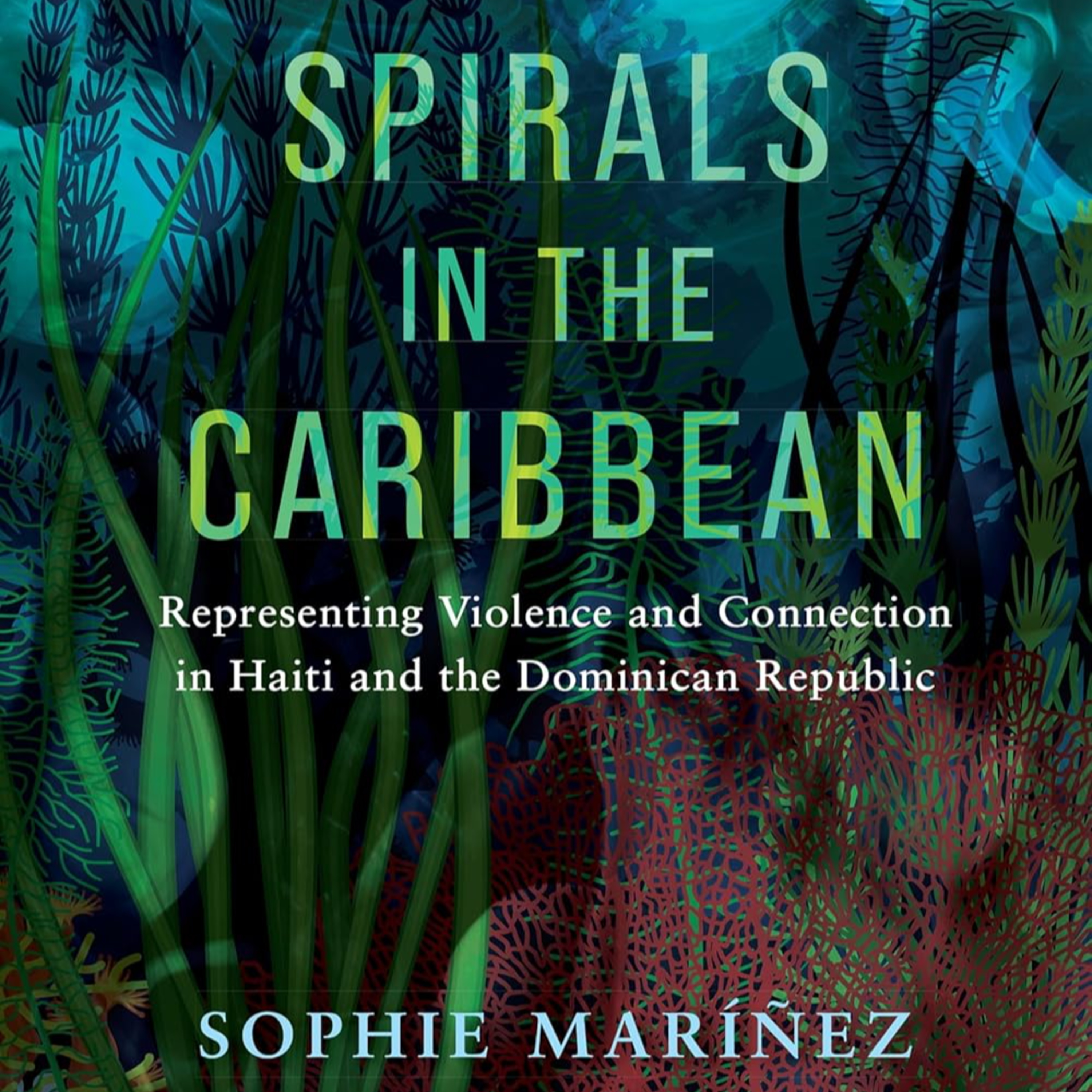
Spirals in the Caribbean: Representing Violence and Connection in Haiti and the Dominican Republic.
Key points
- Sophie Maríñez explains the spiralist aesthetic of Frankétienne, René Philoctète and Jean-Claude Fignolé, and uses the spiral's repetition with a difference in place of the binary story of a fated Haiti and Dominican Republic conflict.
- She draws on Dixa Ramírez's idea that the Dominican Republic has been ghosted by scholarship, and points to new historians studying the island as a whole.
- Maríñez names three foundational episodes of violence behind anti-Haitianism: the conquest from 1492, the Haitian Revolution, and the 1937 massacre under Trujillo, which she calls a genocide.
- She traces the colonial trope of the Negro Incógnito, or Comegente, from rebels in 1790s Santo Domingo to a dehumanized figure still used against Haitians.
- Maríñez explains how the in-transit clause behind ruling 168-13 stripped Dominicans of Haitian descent of citizenship, and describes current mass deportations.
- She calls for cross-island solidarity, urging Dominicans to take pride in the War of Restoration, and recommends Anne Eller's We Dream Together on Haitian support for that fight.
This conversation with Dr. Sophie Maríñez is less an interview than a reckoning for me, an excavation of Haitian and Dominican ghosts, of histories silenced and distorted, the way the past never quite stays in the past–“The past is never dead. It’s not even past”. She walks us through the troubled narratives of Haiti and the Dominican Republic—not as distant, separate nations, but as entangled siblings, bound by history, betrayal, and resistance.
At the heart of her book (and this discussion), Spirals in the Caribbean: Representing Violence and Connection in Haiti and the Dominican Republic, is the idea that history is not linear. Instead, it circles back on itself, shifts, adapts, repeats but never in quite the same way. This is Spiralism, a framework born from Haitian literature that seeks to make sense of the cycles of oppression, revolution, and return. The Haitian Revolution, the Parsley Massacre, the decimation of the island’s Indigenous people—these are not separate moments in time but echoes, reverberating through centuries.
Frankètienne, one of the fathers of the framework, said that Spiralism “…defines life at the level of relations (colors, odors, sounds, signs, words) and historical connections (positionings in space and time). Not in a closed circuit but tracing the path of a spiral. So rich that each new curve, wider and higher than the one before, expands the arc of one’s vision.” (From: Ready to Burst.)
Dr. Maríñez dismantles the neat, binary notions of identity and conflict. Hispaniola? That’s a colonizer’s name. Kiskeya? A myth born from a European chronicler who never set foot on the island. Haiti/Ayiti? One. the true Indigenous name, the other, rendered politically fraught by the weight of nationhood. She insists that there is no singular name, no singular story, only a mouthful: “the island shared by Haiti and the Dominican Republic.”
Dominicanidad, she argues, is no less complex. It is a construct, an essentialist shape-shifter, used and abused by political forces to serve shifting agendas. What does it mean to be Dominican, when the definition shifts by geography, race, class, and time? What does it mean to be from a place that has been “ghosted,” rendered illegible by the very scholars and institutions that claim to study the Caribbean? Ouch.
Let’s stay with the ghosts:
The massacre of 1937 was not just an act of violence but an act of memory, or rather, forced forgetting. The rhetoric of the “peaceful invasion” of Haitians into the Dominican Republic is not about immigration but about erasure, a convenient distraction from the economic and political structures that extract Haitian labor while denying Haitian humanity. The elite, the state, and the power brokers of both nations collude in this, enforcing borders not just of land but of belonging. And yet, the past lingers, history an apparition, unresolved, unatoned for, demanding reckoning.
Maríñez sees spiralism as a decolonized way out of the binary nightmare imposed by the Global North–a more liberating way to understand the history of the island occupied by Haiti and the DR, not as a series of conflicts between two nations, but as a struggle between those who hold power and those who resist it. It is the repetition of violence, but also the repetition of rebellion, of solidarity, of culture that refuses to be erased.
She calls for deeper connections, for a rejection of the cliches and stereotypes that keep Haiti and the Dominican Republic estranged. “We need to get to know each other,” she says. “Not just the stories we’ve been told, but the truths that lie beneath.”
And perhaps that is the real challenge she leaves us with in her book and this interview—to reject the easy narratives, to sit with discomfort, to see the spirals, and to break them.
Kenbe la / Aguanta ahi
Transcript
10,897 words · 47 min read
Machine transcript. Names and Kreyòl words may be misspelled. Tap a time to play from there. Also on Jou.
Konesans.
Patrick Jean-Baptiste Welcome, Dr. Sophie Maríñez. Did I get my end down correctly there?
Sophie Maríñez Very good.
Patrick Jean-Baptiste The book we're going to cover today is titled Spirals in the Caribbean, Representing Violence and Connection in Haiti and the Dominican Republic. Yes. In our pre-interview, we talked about the difficulty of finding one term to describe the entire island occupied by both Haiti and the DR. You said something that kind of surprised me, that Hispaniola and Qisqueya are problematic terms for you. Why is that?
Sophie Maríñez Yeah. Well, Qisqueya has been, recently has been controversial because it's been found that it's an invention of the chronicler Pedro Martir de Anglería, who never set foot on the island and apparently may have made up that name of Qisqueya. There is no evidence that it was used by the indigenous populations. So that's one reason why I avoid it in my book, because I want to be as accurate as possible. And I also avoid the word Hispaniola because it is a colonizing term. It's the Latinized version of La Española, which was the name imposed by Columbus when he, quote unquote, discovered the island. So I prefer to use, you know, and as you know, Haiti is the original name of the island, right? By the indigenous. Now, the fact that Haiti was used by the Saline to create the Republic of Haiti, to name the new republic, has made it difficult to be used by, in today's, you know, times, to refer to the whole island. Because it might create confusion as to which one are you referring to, the island of Haiti or the Republic of Haiti. So that is why we are in this conundrum now. And I prefer to just say the mouthful, the island shared by Haiti and the Dominican Republic. And the other reason is that Hispaniola is not really, it may be the name that colonizers have used, including the U.S., to refer to the island. But none of us, those of us who grew up or who identify as either Haitians or Dominicans, come and say, oh, I am Hispaniolan. I come from Hispaniola. Nobody says that. Either I come from Haiti or I come from the Dominican Republic. Either I'm Dominican or I'm Haitian, but I'm not Hispaniolan. So that's the other reason that I don't use it, because it doesn't refer to the way that the people address, identify themselves.
Patrick Jean-Baptiste You also said you find the term anachronistic, problematic, and confusing. Why?
Sophie Maríñez I said Dominicanidad.
Patrick Jean-Baptiste Dominicanidad, right.
Sophie Maríñez But Dominicanidad is an abstract term that can be interpreted according to any ideology. What is it really, Dominicanidad? And any term in French or English or Spanish, the ending is ite or edad or nes, American nes. What it means is some certain essentialism, essential fixity in time. It's abstract. And it has been so overused and abused. It doesn't mean anything. What does it mean, Dominicanidad? Because what national identity, what it means to me to be Dominican is different from what a person from the 19th century meant. Or somebody from the north of the island sees themselves differently than people from Santo Domingo, from the city. And the same thing in Haiti or in the United States, right? You cannot talk about American-ness. What does that mean when you are people from New York and Tennessee who are completely different from each other? So those terms try to put into one monolithic group a bunch of people who are so different from each other by race, by gender, by time, by region, by social class, and so on.
Patrick Jean-Baptiste What is spiralism? And how does it, can you do a little bit of compare and contrast with the sort of linear binary view of the Caribbean? And how that's not adequate for you, that you prefer the sort of a spiral framework to looking at the island as a whole and its history and culture and experiences and lived experience?
Sophie Maríñez Spiralism is a literary or aesthetic movement that was developed by three Haitian writers back in the 60s. Frank Etienne, René Filoctet, and Jean-Claude Fignolet, who saw the spiral, the shape of the spiral, as permeating nature. We see it in galaxy, in the hurricane, in the conch, and other items in nature. And also were inspired by other philosophers like Friedrich Engels, Marx's friend, who saw that social phenomenons repeat in time in the form of a spiral. They repeat with a difference and that the spiral is the shape that is one of the principles of the dialectic. So there is this repetition, but it's not exactly the same. It will always, this phenomenon will always appear adapting to new agendas, new sensibilities, new changes in time, right? So that is, in general, spiralism. And the writers, Frank Etienne and so on, try to adapt that concept to their literature, to the way that they represent reality in their works. And Professor Kayama Glover, who is one of the main theorists of spiralism and who brought it to knowledge in the U.S., explains how this literary movement is meant to reflect the violence and chaos and social injustice permeating Haiti. But it also has the potential to extend across the Caribbean. And so I took that, you know, that observation as my cue because René Filoctet wrote a novel about the massacre perpetrated in 1937 by Trujillo on the island. And I saw that, indeed, it could be extended to explore realities across the island. And it has the potential to be across the whole Caribbean, not only to analyze literature by spiralists, but also social phenomenon that repeat themselves, right? Or tropes or cultural productions that reemerge in time. And so I apply it to the tropes that I analyze in my book, like the people eater, you know, the massacre of 1937, anti-blackness that comes back in time in different forms and so on.
Patrick Jean-Baptiste We're going to go through some terms because we break things down without dumbing them down for the audience, right? What is l'encontre? L'encontre and repetition with a difference.
Sophie Maríñez Repetition with a difference is really what the shape of the spiral means. You have other philosophers or theories who have analyzed, you know, the connection between the spiral and the concept of repetition with a difference in Western philosophy, like Roland Barthes and Gilles Deleuze. Roland Barthes says that, you know, the circle is a repetition in identity. So we always come back to the same, right? But I contrast the circle is a repetition in difference. So it's always deeper or wider or stronger, right? When it comes back. And Deleuze, the same year that Franck Etienne and his friends published their manifestos and novels about spiralism in Haiti. He, Deleuze, published the book Repetition et Différence in France, where he also developed the idea that realities repeat themselves with a difference. Meaning we have, and there are different levels of repetition. Like, for example, in our daily routine, we may go to the same place every day, right? So we repeat our movements. But then every day there is something different. And then when that happens, like one day it could be raining or snowing or hot. And then one day there could be a change that radically, there could be an event that radically changes the meaning of that routine. Like maybe that one day there is an accident or somebody dies. And then that routine is no longer the same, right? So there is that change that's going to deepen the meaning of that repetition in my daily life, right? So that's one very, you know, grounded example of that. You can see it in other phenomenons as well.
Patrick Jean-Baptiste When I was reading your definition of it, I kept coming back to one of my favorite poets, T.S. Eliot, and the folk quartet, The Little Gidding. I'm sure this will resonate with you. We shall not cease from exploration. And the end of all our exploring will be to arrive where we started and know the place for the first time.
Sophie Maríñez It resonates with him. And actually, I think Frank Etienne mentions T.S. Eliot as already manifesting the aesthetic of the spiral.
Patrick Jean-Baptiste One of the difficulties I have sometimes, and I find myself putting people on the virtual couch, when Haitians get disturbed about what's going on in Haiti and the DR, reading your book, it sort of made me realize that they're looking at the world in sort of a binary way, instead of in a spiraling way, that maybe that might help them more to kind of put things in context. How do you, as a scholar, you weren't obviously trained to do your research or to approach this book from a spiraling perspective. How does it conflict with how you were trained as a scholar to come into this new way of looking at the world, at the island as a whole and its history and its lived experiences?
Sophie Maríñez Yes. Well, I come from different, you know, training and background and, you know, from linguistic approaches and disciplines. But mainly, to sum it up, you know, there is this over-dominant narrative about a so-called fatal conflict between Haiti and the Dominican Republic. And that narrative has been debunked already by other scholars like Samuel Martinez, Robin Derby, Eugenio Matibag, who said that there is no such binary and the relations between the two countries are so much more complex that you can find a wide spectrum of attitudes and sentiments and historical episodes of solidarity and alliances and tensions. And, you know, all of that has, there is so much complexity that cannot be reflected in this very black and white, binary, good and evil kind of things. And so building on their work, I continued expanding where is it really that the conflict resides? Because there is a conflict, but it's not between two states or two nations that are currently at war. You know, you don't see that there is a war between the state of Haiti and the state of the Dominican Republic. What you do see is a conflict between the states and the elite on top and the population below, which is the usual conflict that comes back all the way from the time of slavery, where there was a conflict between the enslavers and the freedom seekers, right? That we know today as the Haitian Revolution. And so that conflict comes back in history between those who want to control and oppress and exploit and those who don't want to, those who are at the bottom and fight against that. That is really the conflict between the top and the bottom, not between these two sides in geography or these two nations. Because like I said at the beginning, also nations are masked to hide the deep complexity of populations within that alleged nation, right? People, it's not the same to be in the elite of Haiti than to be a rural resident in Jacmel or Cai, right? So it's the same in the Dominican Republic. And we know that the elites of both sides, of Haitians and Dominicans, they get along very well. They do business together. They get married together. They get along well. And the states also are complicit in terms of exploiting the Haitian workers and migrate to the Dominican Republic. So there is that complicity. And I'm not the first to say it. Even Jacques Roumain said it at the beginning, at the onset of the massacre in 1937. This complexity between the two governments allowed for that massacre to happen. Or to remain unpunished, right?
Patrick Jean-Baptiste We'll get into that definitely in a few. What is Derrida's Hortology, which is a fascinating concept. And you also mentioned this in your book. He said, quote, The Dominican Republic has been ghosted by scholars, writers, and other local and foreign cultural producers since its inception in 1844. Can you flesh that out for me?
Sophie Maríñez Yes. Well, the term ghosted or ghosting is actually coined by scholar Dixa Ramirez, who published the book Colonial Phantoms, where she argues, and rightly so, that the Dominican Republic has been misunderstood, rendered illegible, or misappropriated or distorted in the U.S. or Western scholarship, including Latin American studies that do not include Dominican Republic. So there is that term. And I connect that with this overall concept of hauntology, which is something that comes from Derrida, but also other scholars like Avery Gordon, who wrote about the haunting of slavery in today's literature, like in sociology also. And she analyzes Toni Morrison's Beloved and talks about how, you know, there is that past of crimes and murders that keeps haunting us, the present, not only the survivors, but also the perpetrators. And so, yeah, so there is a whole field of scholarship in hauntology studies.
Patrick Jean-Baptiste So it sounds very close to Michel Wartouille talking about the silencing of the Haitian Revolution. Is that pretty much along the line of what Ramirez was talking about for the Dominican Republic in the same sense? Or is there a difference between the Dominican Republic being ghosted and the Haitian history being silenced?
Sophie Maríñez Yes. I mean, we could say that, although it's different because there is definitely a connection. The Dominican Republic has been ignored or left aside or not understood properly in its proper dimension. There are other historical reasons for that. Also that in Latin American studies, for example, the focus, when that started as a field in the 1950s, the focus was on Cuba and also on Puerto Rico because of their strategic relationship or, you know, with the United States. So that field was actually sponsored by the U.S. government as a way of understanding or even spying on or influencing Latin American states. And the Dominican Republic was, for some reason, not a target. I think perhaps because at the time Trujillo was serving the United States purposes. But to come back to that connection between silencing, Michel Roff-Trujillo's concept of silencing, I think it's a little bit disconnected in the sense that he was referring to a major event, Haitian revolution, that the West could not understand or did not want to understand or even talk about. They just didn't know how to handle it or they did not want to handle it. It created so much controversy, even intellectuals like Hegel, who knew about it, did not write much about it. Like Susan Borks-Morris at the Graduate Center has written in her book, Haiti and Hegel. So people at the time, even Marx, did not talk much about the Haitian revolution. Isn't that interesting? So Trujillo talks more about an event than about a country.
Patrick Jean-Baptiste Is that still the case in the academy for you today? Like the DR is ghosted pretty much? Are you finding it difficult or is it much more of a burgeoning field now?
Sophie Maríñez It's an emerging field. There are many new scholars in the U.S. And there is a wave of historians who are redressing the narrative, redressing, you know, unsilenced, unsilencing the history of the Dominican Republic and approaching it from an island-wide perspective. Right. Starting with Graham Nestler, who, you know, who wrote about the Haitian revolution as an event that extends across the island and beyond 1804 to 1809. Or Sarah Johnson, who also wrote about the Haitian revolution extending to the Santo Domingo side. Or even Ann Eller, more provocatively, extends it to 1865 when Dominicans were helped by Haitians to finally banish the Spanish from the island. Right. Banishing colonial presence and the specter of slavery, at least physically, from the island. So in that way, that war of restoration that took place in the Dominican Republic in the 1860s is a continuation or the continuation of the Haitian or the purpose of the Haitian revolution. Right. Of banning colonial presence from the island. So, yeah, so there are all these historians who are looking at both sides, you know, in a holistic way. And who, but already in the 1960s, you have a Dominican historian, Emilio Cordero Michel, who already unsilenced the Haitian revolution in Dominican history. He wrote a book titled The Haitian Revolution and Santo Domingo in 1968. And he speaks about the Haitian revolution as the most important event happening in Latin America. I mean, in the Americas. And also not only because it emancipated, abolished slavery, but because it was the first independent state of the Americas after the United States. So he doesn't even say black state. He said the first state, period. The first state of Latin America. So, yeah, so there is a lot of of unsilencing and the field itself is becoming there. There's a lot of young scholars working now in different disciplines, history, but also in urban planning and other fields that there is so much to do regarding Dominican studies. And but at the beginning, it was mostly dominated by cultural studies like identity. What is it to be Dominican? There is an obsession with that. Now we're moving on to to really talking about that history, movements towards freedom, emancipation, the fight for freedom across the Caribbean.
Patrick Jean-Baptiste Another term. What is the 21 division spiritual tradition in the DR? And how are they tied to the the twin Deirdre concept of the Maasar, which you said exists in both Haitian, Voodoo and Dominican 21 division?
Sophie Maríñez Yes. The 21 division is the name that has emerged to refer to spiritual practices in the Dominican Republic that are also known popularly as servir los misterios, to serve the mysteries, which is the name for laws and entities of African descent, just like in Haiti is known as Voodoo. So we just don't call it Voodoo. Although some scholars call it Voodoo, but because the word is associated with Haiti, there is that discrepancy or that inconsistency. We practice it, but we don't want to call it Voodoo. We practice it, but we don't want to call it that way. Right. And so the like in in Haitian Voodoo, the spiritual entities are organized in terms of nation. Right. So divisions are the equivalent of nation. And they have different characteristics depending on which to which division they belong to. And now what I found in the I mean, I didn't find this, but what struck my attention was that within this 21 division, there is one division only dedicated to indigenous entities like Anacaona and Caonabo. So historical figures, but also indigenous figures with no name, El Indio Bravo, El Indio del Agua, La India del Agua. Right. So no names, but we know they are Indians or indigenous. And so I, and, and, and that, and that is not just the name. They are rituals to them. There are songs and prayers to them. There are, you know, ceremonies, there are rules for how to place their, their images on the altars. There's a whole thing. And I was wondering why will Afro-Dominican communities celebrate this? And that's where, that's what leads me to look at the connection between indigenous, historical connections between African and indigenous in the early colonial moment when they ran away from slavery and ran away from the colonial state into the hills and hid together and formed mixed communities. It's exchanging ways of knowing, ways of surviving and forming mixed, you know, ethnically mixed families. And that's why you still have today people in that region, especially in the center island, right? The border, the area known as the borderland region in the Dominican side is San Juan de la Maguana, Neiva, all that area. A lot of, many, many, many people who have Afro-Indigenous phenotypes and their DNA with indigenous DNA is higher than in other areas. And that is significant because the dominant narrative about the indigenous in Dominican, you know, traditions is that they are, they're the mestizos, the Indians who mixed with the white Europeans. So the narrative is about Euro-Indigenous reconciliation, so-called reconciliation. Whereas the Afro-Indigenous is one of rebellion against slavery. And that is very important to mention because it is at the core of later, you know, successors like Desalim, who saw himself and the Haitian revolution as the successor of the anti-colonial battle first fought by the indigenous people. Oh, and marasá exists in the Dominican spiritual practice of 21 División.
Patrick Jean-Baptiste Do they use the word marasá?
Sophie Maríñez Yes, they do. And it's used primarily in the borderland region in San Juan de la Maguana and Banica and Elías Piña. And scholar Robin Derby, who's also a historian, she has done a lot of research on that and has actually attended rituals for the marasá in Elías Piña. She also published articles about that.
Patrick Jean-Baptiste I want to talk to you about one of the mental scaffoldings you put in this book beautifully, the three foundational episodes of violence. You wanted to shed new light on the root causes of anti-Haitianism, on debates about, you know, national identity, migration and human rights. You said in order to dismantle those dominant ideological edifices, so subaltern voices, which you mentioned earlier, could be heard. You said you found three sources to anti-Haitianism and three foundational episodes of violence. Let's talk about each of them. The first one you said was the Haitian revolution.
Sophie Maríñez Yeah.
Patrick Jean-Baptiste The second was the 1937 Parsley Massacre. I don't know if it's even appropriate to call it the Parsley Massacre. We can discuss that. And the third, you said, should actually be first chronologically is the decimation of the indigenous population starting in 1492. You want to start with the third one first since it starts in 1492 or you can go in whatever order.
Sophie Maríñez The thing is that the last one is the first one, but I'll explain why. So it's, but anti-Haitianism actually starts the minute that Haiti is born as a new nation, obviously, right? The 1804 is a moment of liberation of all the former slaves and at the same time, dispossession of the former enslavers. So those enslavers are going to develop anti-Haitian sentiment. It's completely understandable from their perspective. And many of them fled to New Orleans or Philadelphia or Cuba, maybe went next door to Spanish Santo Domingo. And so the anti-Haitian sentiment in Santo Domingo, which later became Dominican Republic, manifested in several tropes that demonized Haitians. Some tropes of Haitians as rapists, as savages, and also as cannibals. And that tropes of Haitians started in 1791 already with a figure known as El Negro Incognito that people call El Comejente or the people here. And it was not referring to Haitian at the time. It was referring to local insurrections that were also taking place in Santo Domingo at the same time, but which never developed into a full-blown revolution. But the authorities were very scared, obviously, because they were seeing what was happening in Santo Domingo. And so they were calling Spain to send reinforcement. And as an example of how ferocious they were, the authorities appointed the attention to this Negro Incognito that was doing all of this and the people called El Comejente. Then the authorities sent, you know, sent through men to arrest the insurgents, the people who were rebelling, and made arrests and either punished them or re-enslave them and so on. So after that, we don't hear anything from them.
Patrick Jean-Baptiste But in the next... Let me ask you this, Sotac. So the Negro Incognito, is it one person or is it a group of people or all of the above?
Sophie Maríñez Yeah. It was a group of people. It was a group of rebels. But they, in the letters from the Spanish authorities, you see that they somehow, they summarize it or they think that it's only one person committing all these crimes in every different town and who has supernatural powers to fly from one town to another. It's kind of a superstitious thinking. But when they send authorities after this so-called Comejente, the authorities himself, Pedro Catani, writes, we arrested them and we really, because they, and there were many of them. There were not just one Comejente, but many Comejentes, criminals, who need to be back, to be put back to work. And we arrest... So he is a materialist. He doesn't believe in superstition. And he understands that all he wants is to get all these fugitives back to work. Right? And also, he says that what is... The problem for him is not whether they're freed blacks or enslaved blacks, but that they're good or bad blacks. The ones who work for the system, who are productive, who we can control, and those who are outside our control, who are the rebels. Right? So it doesn't matter their status. What matters is how they serve or not the colony. Now, in the 19th century, 100 years later, historians don't talk about those insurrections. But they do talk about what stayed as a folktale of one Comejente. And then, that is one man who goes to El Francais, or Saint-Domingue, a Spanish man, who then was put accursed by the African slaves in the story, and transformed into a monster who becomes a people eater. And that transformation of the legend served the purpose of creating a psychological taboo between Haiti and the Dominican Republic at the time where there was a lot of anxiety because the border was not yet defined, clearly defined. So they needed a psychological border. If you go to Haiti, bad things are going to happen to you. And then, 20 years later, you see again El Comejente transformed, amplified. Now he is fully Haitian. And that is a man who roams around villages looking for misbehaving children and take them away and eat them. And he mates with Dominican women and have children who are as monstrous as him. So that is referring to two things. The guilty conscience of those who committed the genocide in 1937 and killed many children because many Haitian babies were killed. And then, so they were guilty, right, of retaliation from Haitian survivors who could come back and do the same to their children, number one. And number two, there is José Francisco Peña Gómez in the 1980s and 90s who is a survivor of the genocide and becomes one, perhaps the most phenomenal political leader in Dominican history and who's running for the presidential elections. And so the anti-Haitian rhetoric at that moment serves one new purpose, which is political elections, to serve, to gain political power against these men and win the elections. So I stopped there with José Francisco Peña Gómez in the 1990s. But we can see it. I couldn't imagine that it would come to the United States a few months ago in the form of the cat-eater. Cat-eater. Out of the blue, we see that the anti-immigration rhetoric, which in the past was primarily anti-Mexican or anti-Central American, all of a sudden we see it against Haitians, who are the most peaceful people in the world in this small town in Springfield, Ohio, legally migrated from this program of the TPS by Biden, working where nobody else is working. And there was nothing wrong about them. But somehow, right, we have to use that trope again, old trope about Haitians being pet-eaters. But it preys on the very old, very old characterization of Haitians as, you know, cannibals, savages, etc., that I don't even want to repeat.
Patrick Jean-Baptiste But it's interesting. You mentioned, correct me if I'm wrong, you said the Negro Incognito, before he morphed into El Comerente, he was African-based. He was more African, right? Or did he, he was Spanish at some point? Can you talk about that? Like he had family and then all of a sudden he morphed?
Sophie Maríñez Yeah, that is in the iteration in the late 19th century. Where he feel a family man. And then later, in the 100 years later, he's no longer a family man. He's just a rapist. So he's fully, fully dehumanized. So you can see the evolution of the trope, how the same figure changes over time, serving different agendas.
Patrick Jean-Baptiste And it's the elite that is pushing this narrative, right?
Sophie Maríñez Yeah. At the end of the 19th century, this is an elite figuration because most of the people don't have access to literature. I mean, to be a writer, you have to be from the elite at the time. But right now, it's different because everybody has access to social media. So the tropes circulate a lot faster and spread and everybody takes and it gains traction. So that's also another difference from that time. So that's the first moment. You want to talk about the second moment?
Patrick Jean-Baptiste Yes. Go ahead.
Sophie Maríñez So yeah, so Trujillo in the 1930s is usually considered the main culprit of the genocide. I call it genocide. Committed against tens of thousands of Haitians and Black Dominicans who lived along the border with Haiti. Primarily, they were residents. They were not just temporary migrants. And, you know, many people already know that Trujillo, what he did was to solidify the anti-Haitian ideology that existed in the 19th century that I just mentioned, the Comerente and so on. He solidifies all that with a new wave of anti-Black racism that had been adopted from the U.S. occupation in the 1916, 1920s. All those U.S. Marines, they had infused additional layer of anti-Blackness. And so he solidifies and he uses that ideology to maintain, to solidify his power. The massacre is, as Richard Turitz, historian, and other historians have shown, is a show of power. So if you, look at what I could do. I can do this again if you dissent, if you rebel, if you are different, if you don't conform, if you don't obey. So that's what fascism is. I also analyzed in 1929 the Constitution of 1929 that gave the legal framework for this massacre. And that is connected to the court ruling issued by the Constitutional Court in 2013, La Sentencia, or Court Ruling 168-13, which stripped of their nationality, Dominicans of Haitian descent. So everything is connected in that, and which has been associated by many as a modern manifestation of the genocide. We don't do genocides anymore because, right, unless you are certain countries, because it doesn't look good. You can have international opprobrium for that. But there are other forms of excluding and also of keeping certain populations always under the thumb of the elites. And actually, it's not good business to kill people. Just get rid of their documentation and so that you can exploit them and do whatever you want with them, right? It's a new form of enslavement, if you will, which is the white fantasy of the elites. That's what they want. They want to find cheap labor wherever they are, whether it's in the Dominican Republic, the United States, anywhere. So the third one is the genocide committed against the indigenous population during the early colonial moment, against the Tainos. That moment is the first chronologically, it's the first. But I put it last because it comes back for the purposes of national narratives, Haiti and the Dominican Republic. It comes back in the 19th century as the material that will serve national narratives on both sides of the island. Sincs Dessalines, who named Haiti after using the indigenous name and also considered the Haitian Revolution as avenging the indigenous across the Americas for the atrocities committed against them by the Europeans. And he says it like that. And also naming the Haitians as the new, le nouveau indigène, right? And l'armée indigène. And so there is all this vocabulary. And then you can find that, all that vocabulary of considering the nation of Haiti as the heir or the continuation of the anti-colonial battle first waged by the indigenous population. And that line of thought, you find it in Haitian literature and also intellectual work of different authors like Baron de Vastey and Émile Nault in the 19th century, connecting the Haitian history with the indigenous history. There is always like works of literature, like plays and novels, connecting, making analogies between Dessalines or Toussaint Ouverture and Caonabot or other figures from, you know, how their fights are mirroring one another. So you find that connection in Haiti. And then on the Dominican Republic, also you find a connection in national narratives about how the Dominican Republic is the result of a so-called reconciliation between the indigenous rebels like Enrique, also known as Enriquillo, in the famous novel by Manuel de Jesús Galvan, which is known in Latin American literature as one of the main examples of indigenista literature, where the rebel Enriquillo then reconciles, so-and-so, between quotes, with the Europeans. And that is the template for the so-called Dominicanidad or the idea of the Dominican nation that late 19th century writers had because they wanted so badly to be recognized as, in terms of affiliation with Spain, as the daughters or the daughter nation or the children of Spaniards. They had to, but they did not want to acknowledge the African contribution at all. And that scholars like Doris Sommer and Franco Pichardo have already observed that, that the indigenista literature of the Dominican Republic completely erases the African contribution. And the narrative is only about Europeans and indigenous. But I say in my book that that novel, Galvan's novel, is not indigenista, it's anti-indigenista. Why? Because Enriquillo has to renounce to his identity, his language, his religion, his customs, to submit and to become a subject of the Spanish Empire. And that is really a different, the way that this moment of violence against the genocide re-emerges in the literature, in the narratives of the 19th century, to this day, to the 20th century, because you have more writers like Jean Metelus in 1980s, wrote the play Anna Carona. So he's still writing with that, connecting Anna Carona with the current moment in Haiti. And in the Dominican Republic, you also have more writers that connect that indigenous past with the present.
Patrick Jean-Baptiste So let me, from the mindset of the Dominican Republic, you talk about this reconciliation with the West. Are the atrocities committed by the Spaniards? What happens to that in the history? What becomes of those atrocities? Did they just disappear from the history books? Or are they reconciled?
Sophie Maríñez There is no such reconciliation. It's a fantasy. There is no such. They were killed. The indigenous were killed or they were raped and subsumed, right, into Euro-indigenous families. But women were part of, you know, raped by Spaniards. And then the children were more or less integrated into society, depending on each family. And then you have the indigenous who fled to the mountains, to the rural areas, who mated with African captives, like I mentioned before. So there is no community of self-identifying in the, you know, Taino, pure Taino. And those who do are negating that history of genocide and marronage and mixing and slavery and all that. You know, like, miraculously, you will be surviving as a pure Taino today. That's not reality. And that reconciliation is a fantasy. The Spaniards just imposed themselves. And they had the power. And that was the end of it. And those who were under it, whether you are indigenous or African, you had to either you sublisit or you run away. And that's it. Right. And then in the end, you know, we have that phenomenon that was so well explained by Frantz Fanon of internalized racism. Right. How the people of mixed ancestry or black ancestry have internalized the idea that to be black is to be inferior. So that is what we find. And the admiration of white and Western and all that.
Patrick Jean-Baptiste Is that still prevalent in the DR today?
Sophie Maríñez Oh, yeah. Definitely. I mean, there are movements, you know, of reclaiming history. There are more intellectual. Of course, there have been historians and scholars who have reclaimed and excavated the African contribution, black contribution to history and culture and everything in different fields, even in music and the visual arts. You know, there are. But the dominant ideology is still pretty much racist, anti-black, as we can see today by this state sponsored persecution of not just Haitian, but black people, black men and women who are Dominican are also being detained and having their ID documents taken away from them. And then they are put into detention centers, Haitians, whether they are immigrants or non-immigrant, documented or non-documented, you know, Dominicans, they're all put into these detention centers that are hideous and, you know, horrendous. And then they have to pay money to be agreed. So it's a state sponsored form of kidnapping that's very much similar to what is going on in Haiti with the gangs.
Yeah.
Sophie Maríñez There's no difference. Well, the only difference is that they don't get killed. But I wouldn't say maybe some do. But it is that kind of extortion that is sponsored by the Dominican state right now as we speak. There is a Haitian writer, Jacques Valcourt, who resides in the Dominican Republic and who wrote a fantastic essay recently because he was detained and put into that detention center. And he wrote it. What we are in Spanish is lo que callamos en la camiona, like what we silence in the truck, the truck meaning the, you know, that where they take migrants. Jacques Valcourt. So he might be somebody you might want to interview.
Patrick Jean-Baptiste I've seen that name before. Yeah. I want to go back to the Dominican Republic's court ruling 168-13. Can you explain the in-transit exception? Yes. That's a very interesting clause. It's a way of talk about that. You say it's tied to the 1929 constitution, right? What is the in-transit clause or exception?
Sophie Maríñez Yes. Well, it all starts in 1929 when the Congress, the Dominican Congress, wanted to recapture land that they claimed had been lost to Haiti and that belonged to the Dominican Republic in virtue of the old Treaty of Arangües that France and Spain had signed in 1777, where a very large chunk of land in what is the Artibonite Valley today used to belong to the Spanish side. So the Dominican said, we want to reclaim that land. And because the border had not been officially defined, they said they changed the constitution in January 1929 to say that the territory of the Dominican Republic was the same as the Treaty of Arangües. And soon after that, but during that, the deliberation between the congressmen, one of them said, what are we going to do with the population of that land if Haiti actually gives us what we want? If Haiti gives us the land that we want, what are we going to do with the residents of that land who are Haitians? And he was coming from the place of the Treaty of Versailles in 1919, which ended World War I and severely penalized Germany, reshuffling the land that belonged to Germany across neighbors. So the people of that land will have a new nationality that maybe they didn't like, right? Like maybe you're German today, you don't want all of a sudden to be Polish or another nationality. So the Treaty of Versailles had this clause to protect the rights of minorities. And that is when the concept of minorities becomes, you know, to exist, which is that this population, the new state will have to respect their culture, their language, their religion, etc., etc. So that is the principle of protection of minorities. Now, this congressman was saying Haiti could very much tell us, OK, we give you the land, but you have to protect the rights of the population of that land to keep their Haitian culture. Right. So they don't say anything. The congressman after that, they don't say anything. They just passed the law, the new constitution, then the border, new agreement between the president Barnaud in Haiti and President Vasquez, Dominican Republic. They signed a new treaty and they are giving not the entire region of Artibonite, but a very generous chunk of land. And so three months later, Congress convenes again to change the clause on nationality. And they say they modify the juicoli, right, the birthright on the base of the land. Like if you are born in the Dominican Republic, you are entitled to nationality. And that was the most democratic clause until then. And they insert the new exception. And they say are entitled to nationality. All those born on Dominican soil except the children of diplomats and the children of those in transit. So, again, the congressmen are deliberating whether they should or not include that. And one of them says, don't you find that a little harsh because the children of foreigners will not be able to claim nationality, Dominican nationality. And the person who defends that clause, who is a congressman representing a province close to Haiti, Aswa, he says, we must include that. Because these people, they cross, but they never stop. And I found that particular choice of words very telling as to which kind of foreigners they were referring to. Not people who came from by sea, right, in boats, because at the time you didn't have planes. Since 1929, you could only arrive by ship, by boat, by sea, or by land. And so he's referring to those who were crossing from the next neighbor land, right? So there is no question they were referring to them. And at the time there was a lot of mobility. A lot of mobility, you know, between both sides. For example, many Haitian merchant women, marchantes, marchantes, who came, who went from Port-au-Prince to the Dominican side to sell lots of manufactured products, imported products from France, perfumes and all that, that the Dominican Republic didn't have at the time. So they didn't want, and then they said, these people come and go, and their children, if they're born here, they can go back and claim two citizenship, two. And dual citizenship was very problematic at the time, because nationality is not just what Benedict Anderson called to belong to an imagined community, of people that we all share a certain culture and so on, which is one definition, but it is primarily a political allegiance to a nation. You are loyal, especially in terms, because it's a concept that comes from a time of conflict and wars. So if you were French, you cannot be Spanish, because they're always at war. So you have, at one point, you have to decide on which side you are. The same thing with Haitians, and especially these Dominicans who had a war-like mind, right, conflict mind, and they couldn't handle the idea that a person could have both Haitian and Dominican identities. And that is still the problem today. As you can see, either you're Haitian or you're Dominican in Dominican law, in Dominican constitution. If you were born from Haitian parents, you have a very hard time to claim Dominican citizenship. If you are like me, born from a French mother, that's no issue. No issue. You can claim your Dominican citizenship very easily. And, but if you were born from, you know, you have to have at least one Dominican parent to claim Dominican citizenship.
Patrick Jean-Baptiste How are black, non-Haitian blacks coming to the Dominican Republic treated?
Sophie Maríñez Yeah, of course. There is anti-black racism permeating Dominican Republic, but, and it's also connected to poverty, because they are the most impoverished population in the country. And so there is a lot of police brutality in poor neighborhoods constantly. Poor Dominicans are being killed all the time by the police. That's not a secret. They are arbitrarily detained in the street. They are, there is an assumption that they're criminal. There is an assumption because also poverty pushes you to all kinds of, you know, survival strategies. You, you, you know, you end up sometimes breaking the law. So you are, you know, subject to, to persecution by your own state. If you are a black citizen who is, happens to be poor too. You have to be both, right? And obviously Haitian migrants are also very poor. So if you are not poor, you're, you know, they say that's the best nationality to have money.
Patrick Jean-Baptiste Can you talk to us about the decolonizing movement, Afro-Indigenism and the DR? When did it start and what's its current status?
Sophie Maríñez Yeah, I mean, I identified that movement. It was not like, it was like we are a movement. There are different loosely articulated groups that are in the 1980s responding to the commemoration of the so-called quintessential quintessential of the discovery of the Americas in 1992, which the then president, Dominic, the then Dominican president, Joaquin Balaguer, was very intent in celebrating because he was a pro-Hispanophile, a Hispanophile. And so there were different events to commemorate and two, most importantly, the construction of the Columbus lighthouse that displaced hundreds of families and also the reception of the three replicas of the caravels in which Columbus arrived, except that they made him arrive in the, to Santo Domingo, where Santo Domingo is, when in history he arrived to where Tapaitia is. So they don't want to recognize that Columbus arrived to the site that is today Haiti. They have to distort the history, right? So there were many scholars and artists and musicians and artists in general that denounced that, like, how can we celebrate the arrival of Europeans when they were the first to commit genocide and enslavement and all that? And that manifested in literature. I mean, they had protests at that event of the arrival of the replicas. And then in literature, I found, and in music, I found works by Luis de Rordias, who wrote poetry and different musical pieces in homage to the indigenous and in general, you know, described or dug deep to see the connection between African and indigenous alliances and marronage.
Patrick Jean-Baptiste This is more of a personal question. Do you impose a spiralist framework on your subjects, or do they reveal their spiral shapes the deeper you dig?
Sophie Maríñez Well, I don't impose it. I mean, I'm not the one who created spiralism. It was, I am inspired by movement created by Haitian writers, Franck Etienne, René Fulocet, and Jean-Claude Fignolet. And for me, it's very important to use the way that people who live on the island, who have spent their whole time thinking about the realities of the island, and, you know, what they came up with and build on that and expand it and amplify it and circulate it. So my work is really an expansion of something that really began with on the island in Haiti. Right. And so, and because of that, you know, I don't expect other writers to write like the spiralists, but I find, I take it to the letter when Franck Etienne says that there are rencontres mysterious, that there are things repeat that you find, you know, especially in my analysis of El Comerente. It was way before I came across spiralism. I had already started and I had noticed, oh, look at this Comerente that keeps coming in history, but it's always different. Right. And so when I come across spiralism, I say, oh, this is the framework that can help me analyze and write and give language to this phenomenon that I'm finding. Right. And, and that, and that I can do, whether it's El Comerente or that it's Afro-Indigenous connections or is the connection between the massacre and the court ruling in 2013, there is that the spiralism helps me as a scholar, as a, you know, literary critic or, you know, as a scholar in general to see these connections over time. I see my work as a contribution that helps us go beyond the binary nightmare. We need to get out of this binary and see more the world in terms of the connections between one and the other. For example, Marassa, the Twinks, earlier scholars like Alfred Metraux, for example, who, who has worked a lot on Haitian voodoo, he understands the Twinks as inherently antagonistic, like enemies to each other. But Marassa is actually a repetition with a difference. It's like the same, but with some things that are different about the first, right? So, and then the third, Marassa Trois, is even more powerful than the first two. So it's really a repetition with a difference. Marassa is one example of that.
Patrick Jean-Baptiste I want to talk about cross-island solidarities. You, you wrote this. Dominicans should feel as proud of the War of Restoration as Haitians do of the Haitian Revolution. End of quote. You mentioned an important generation of intellectuals who, after Turrio's assassination, I think in 61, excavated examples of cross-island solidarities. So first, for the audience, who know quite a bit about Haitian, the Haitian Revolution, but maybe not so much about D.R.'s War of Restoration. Can you summarize the War of Restoration first, before you discuss that generation of intellectuals?
Sophie Maríñez I can't summarize it in one minute. But I will invite readers to read Anne Ehlers' book, We Dreamed Together, which is really an amazing work of research on that moment, from the time of the annexation to Spain, and how the Dominicans were humiliated by the Spaniards, and then how Haitians contributed to their fight for freedom. And so I will refer everyone to read that book, Anne Ehlers' We Dreamed Together.
Patrick Jean-Baptiste So spoken like a true scholar, you don't reduce the complex subject. Perfect. So, but can you talk in general then about how your comment about Dominicans should feel as proud of the War of Restoration as Haitians do?
Sophie Maríñez Yeah, I mean, when I read Anne Ehlers' book, really, I was in awe about this amazing show of bravery and fight against the possibility of slavery coming back to the Dominican Republic first, and the whole island. And so you find that, why is it so important? Because is it an anti-slavery, anti-colonial fight? And it has been silenced by Dominican historians, or maybe not silenced, but downplayed. Dominicans know about it, but they don't know the significance of it, and really the reasons why they should feel proud about it. Because the ones that Dominican traditional historians emphasize is the separation from Haiti in 1844, as if this was really a sign of sovereignty, and really the values that we want to promote. The separation from Haiti promotes independence, yes, but independence from another state that had fought against slavery and against colonialism. So it is an anti-Haitian ethos, right? And many Dominicans don't understand Haiti. Yet they don't understand the value of the Haitian Revolution and of the, you know, in history and for the world. So they repeat this anti-Haitian narrative without thinking really what it is that they're doing. Whereas the War of Restoration is an anti-colonial, anti-slavery war waged by Dominicans that is as noble or as, you know, a source of pride that Dominicans could have, just like Haitians do with the Haitian Revolution.
Patrick Jean-Baptiste You touched earlier on cheap labor. I wanted you to flesh that out some more for me. I'm going to read this section. You argue that the Dominican nationalist discourse trope of, quote-unquote, peaceful invasion, not only imperils Haitians and Dominical Haitians in the Republic, but also serves to mask a pervasive ambition over Haiti itself, territorial, political, and economic, as the importation of its cheap labor revealed. There's always, in the sort of dehumanizing tropes, there's always very practical reasons behind them, right? They don't all exist in the abstract, do they?
Sophie Maríñez No. I mean, you know, usually all this, you know, racism, racist rhetoric, it's always a projection of what the perpetrator is actually doing themselves, right? Because, for example, in Haiti, you have access to Dominican products in the supermarkets. You can find Dominican beer, Dominican food, Dominican products, that one. But in Dominican Republic, you can't find Haitian products. You find maybe some, you know, vegetables, mangoes, or avocados, but we don't know where they come from. They could be from anywhere. So, but the manufactured products from Haiti don't make it into the Dominican side, or very little. So, there is really an invasion of trucks coming, or there used to be before the current situation, of trucks of commerce from the Dominican Republic into Haiti. That is really the invasion happening. And what we are bringing from Haiti, the Dominicans, is workers, because we need their cheap, quote-unquote, cheap, not because the Haitian workers are voluntarily offering them to work cheaply, but because they're imposed a cheap wage. And also because they're desperate, they're coming desperately from Haiti, from the poverty and the situation in Haiti. So, Dominican Republic is taking advantage of that situation. And the Dominican state, when I say Dominican Republic, I refer to the state and the corporations, the companies that make, that have power in the decision-making process. They are exploiting the labor. They are invading the Haitian market with their products. And in the meantime, they are portraying Haitians as the enemy. But when you think about it, the wealth of the Dominican Republic has been built by Haitian labor for the past, how many years? I mean, for a whole century. But they have to portray Haitians as the enemy so that Dominicans don't see who really is the enemy. You know, corporations, the U.S. interventions, and don't fight against policies that are unpopular. It's the same thing that we see here in the United States.
Patrick Jean-Baptiste And the conclusion, you talk about lingering troubles. You want to pick a couple out of that?
Sophie Maríñez Your first question about huntology and hunting, right? Because something that's lingering trouble is hunting. Something, some of an unfinished business that we have with the dead or past murders or skeletons in the closet, right? And those lingering troubles are the unresolved social injustice, unresolved murders like the 1937 genocide. And that is because nobody was kept, you know, there was no accountability for those who committed those crimes of the genocide. And the dead never found justice. And many of them were even not even buried, right? They were burnt. They were left out to be composed out in the open. That, I wouldn't say spirit, that memory of what happened is hunting. And it's creating this guilt that made that. And then when you feel guilty, you have two ways of dealing with it. A positive, healthy way, which is take ownership of what you did. Take responsibility. And make amends if you can, right? Or blame the victim. Project, make them the enemy. Make them, you know, justify your actions by making, you know, rationalizing it, right? And this is what is happening right now. The second one, right? The Haitians are coming for our jobs. They're invading the country. There is a Haitianization of the culture. Oh, that's the other thing I wanted to mention before. That they're saying that the Dominican identity is in danger because there's so many Haitians that are Haitianizing. But really, you don't see Haitian music. You don't see Haitian products. You don't see any Haitian cultural dominance in the Dominican Republic. What you do see is a lot of American culture dominance and businesses and music and everything from the United States. And that doesn't bother anybody. People enjoy going to the malls and buy American products and listen to music and everything American, right? So if there is a threat of losing yourself as an identity, it comes from the U.S. It doesn't come from Haiti. So that's why I call a mask this so-called conflict between Haiti and Dominicans. It's a mask so that you get blinded with this idea that Haitians are the enemy and not see your true threats. So those are the lingering troubles going on, lingering.
Patrick Jean-Baptiste You also said that in the Haitian literature, the way they view the Dominican Republic is more of a, I think you mentioned Edouard Ducat in there as well, it's more of a betrayal. Can you talk a little bit about that? Like how, from the Haitian literature, how they view the relationship between the DRs?
Sophie Maríñez Most Haitian writers focus on the massacre or the genocide perpetrated in 1937, right? From Jacques Roumain, Jacques Stéphane Alexis, Edouard Danticat, René Fulotet, and even Roxane Gay here in the States. And then you find two, you know, a dominant image to represent both nations is that of siblings or friends, neighbors, right? So that is the positive, the positive image, which I believe in and that we really are. But then siblings sometimes can have a tension and conflicted relationship, right? And so, and I found very interesting the word used by the survivors of the genocide, calling it kut kuto. Kut kuto in Kheol means knife stabbing, but also backstabbing, like betrayal. And so I found that it makes so much sense because not only does it refer to the way that the massacre was perpetrated, mostly with machetes and knives, but also because metaphorically it felt like a betrayal from the population that they considered as their friends and relatives and siblings, right? So that is, and now you can see it in Jacques Stéphane Alexis and you find it in Danticat and Edouard Danticat. It was felt and experienced as a huge, profound, devastating betrayal. And there's nothing more harrowing than betrayal. You know, when you trust someone and they're the ones who turn on you, that's horrible. It's worse than an enemy coming, somebody, a stranger coming into your house. You expect a stranger to be hostile and attacking you. You don't expect a friend to do that to you. So that's why the other traumatic aspect of Kut kuto or the genocide.
Patrick Jean-Baptiste Because the idea is, it doesn't seem like to expel all the Haitians out of the Dominican Republic, right? But it's to keep them in this kind of like legal ghost-like state, right? Where they don't really have an identity associated with the DIA, but they can extract and exploit all the laborers they need, right? Is there a movement like to push all of them out of the country? Or is it in general, like in the history? Or is it more of like, let's keep them in this ambiguous legal state so they can have the land and they can have all the benefits right now?
Sophie Maríñez Yeah, right now? Well, President Abinader actually issued a decree a few weeks ago, almost a month ago, where he vowed to expel 10,000 Haitians a week. That's a lot of people. Imagine how you have to concentrate all the state power to go into a manhunt, to find them wherever they are at night, take them out of their houses and separate. If they're not with their families, separate families, mothers separated from their babies. It's just horrendous. The violence has been committed. And I really don't understand this personally, you know, except that that is a tool to please certain sectors of the population who are convinced that Haitians are the enemy. And also to divert the attention from other things that the Dominican government is doing, which are very unpopular, like a recent tax reform that everybody has been protesting against. So let's not talk about the tax reform. Let's talk about the Haitians, right? And that is another way. And the Haitians who are being persecuted are paying the price for that political strategy.
Patrick Jean-Baptiste Did I leave anything out, Professor?
Sophie Maríñez Well, I'm only so happy to have this conversation with you and your interest and engagement with my book. Thank you so much. I hope more people read it. And yeah, I see my work as a form of contribution to understanding this very complicated story between two populations that are siblings, that are very close to each other. And I just need to understand each other a little more and to be open and to get to know each other, really, not beyond the stereotypes, beyond cliches and the narratives, to really get to know each other and to exchange and to grow by exchanging with one another. And, you know, some people say, oh, but we don't speak the language. They say, well, you don't speak French and you go to France and you don't speak Italian and you go to Italy and appreciate going to Florence. And so don't give me that, you know, because when there is a will, there is a way. And you can see, you can make the connections if you want to.
Patrick Jean-Baptiste And Professor Cecilia Celia's book, Teaching Haiti, there is an essay in there. I think it was written by Gina Elise. She talked about, she talked about, another scholar, she talked about how the art, Haitian street art, is Dominicanized and presented to the tourists in the Dominican Republic as Dominican art.
Sophie Maríñez Who's that?
Patrick Jean-Baptiste Cecilia Celia. Ah, okay. Her book, Teaching Haiti, one of the essays talks about, you were talking about earlier about, you know, the commercial aspects of it, where Haitian art, there's like a whole industry of Haitian art that is being sold in the Dominican Republic as Dominican art, not Haitian art. That it's a whole industry.
Sophie Maríñez I don't know, really, that phenomenon. And I would love to read Professor Asilien's book to, you know, to see what she's referring to. I do know that there is a history of appropriation of Haitian cultural productions, intellectual production, literature production, all the way to the 19th century. Since Manuel de Jesús Galvan, his novel on Enriquillo draws lavishly, to say it mightily, from Emil Noe's Histoire des Caciques. And there are chunks that I know because he spoke French, he was fluent in French, so he could have totally borrowed without giving credit, of course, because he was anti-Haitian. So he's not going to give credit to Haitians, but he's going to draw from them. And also in music, a lot of, you know, borrowing from Haitian musicians. So there is a long tradition of taking, without giving credit, what is known as epistemic violence, right? You take ideas and material and then you, you know, plagiarism, and you present it as your own. And it is, and it's part of this whole idea that, you know, to perpetuate the idea that Haiti is incapable of contributing anything to the world other than, you know, migrants or violence or, you know, the stereotypes, the bad news that we always hear. We never hear good news about Haiti, right? We don't rarely hear about Spirulism and Conquetien and the great writers. Few of us understand that Haiti is a regional power in terms of literature production, for example. None of the islands of the Caribbean have as many amazing writers as Haiti. You could teach a whole year of Haitian literature, showing, teaching a different novel every week. That's how many from the 19th century to today. This is amazing for a country with so few resources that they are so prolific in terms of literature, for example. That alone is a treasure. It's a treasure. But it is part of that, right, of this demonization of Haiti and of Haiti being presented always as the poorest country of the hemisphere. Really, that's all you can say about Haiti? How about you say, Haiti, the country that first abolished slavery permanently. I would like that tag to be added to Haiti every time we talk about it in the news.
Patrick Jean-Baptiste Well, thank you, Professor. I appreciate it. I appreciate your work. As you know, I carried this all the way to New York when we met. I've been reading it ever since. It's a great, great piece of, I mean, it opened my eyes about a lot of things that I didn't know. And I hope we do more series like this, more episodes like this on the Dominican Republic in Haiti. You know? Yes. But, yeah, to have a counter-narrative against the stuff we hear all the time online, you know?
Sophie Maríñez Yeah, so, you know, yes, let's have more conversations about it. Other people who might be interested in, I would love to hear other people's thoughts of what, you know, the book made them realize and how they connected with their own work also. That is the whole purpose of this book is to, you know, expand conversations on this very complex subject. Thank you. You're very welcome. And thank you so much for inviting me. Have a great evening. Thank you. runner Racine Basil
Lori black
Sophie Maríñez Psalm Patrol Thank you.
Eh ai SAY
Sophie Maríñez Here we go. ! ... Thank you. Singing CHANGER DW nhất kau Personen唱 Thank you.
